John Pexton Clark was born in Hedon, Yorkshire on Sunday 27th of August 1916 to William and Elsie Clark.
Growing up he developed a passion for sports, especially athletics, holding his final record as Black Heath Harriers Running Club’s oldest surviving member.
When he was called up into the Army, John was living in London and working for the Land Registry where he, funnily enough, worked in the same office as his future wife Delys.
Known to all as a kind, thoughtful and highly intelligent man with a great sense of humour and an enormous interest in the natural world, qualities which he never lost.
This book is the full detailed account of the war kept by John, written up and designed by his granddaughter, Kirsty, in December 2019.
It is impossible not to be inspired by his humanity and observations of life, death and camaraderie; a true account of an ordinary man in extraordinary circumstances.
My army career started on the 16th of May 1940. Eric and I were called up on the same day, he went to the R.A.M.C., myself to the R.A. Signals at Colchester.
The first few days were spent in waiting for stores, clothing, medical and dental inspections and inoculations, also an address by the C.O., a Major Maxwell.
Colchester Barracks are dingy and brick-built, with iron beds, and designed with the Cavalry in mind. The town itself is pleasant enough. Plenty of pubs: The Cups, The Fleece, The Dragon, The Cross Keys, and Canteens at the Moat Hall and St Peters; plus numerous little cafes and pie shops, which all became familiar during the next few weeks.
After two or three days we started our training in earnest. Marching, P.T., elementary Gunnery and Morse. Gun-drill was done on an old 1914 War 25 pounder and limber, though this was taken away from us after Dunkirk and given to an active Regiment.
If we were short of weapons we were well off for Military Bands. There were two: one a Cavalry Band who played on the Barrack Square, and we were drilled to martial music on several occasions.
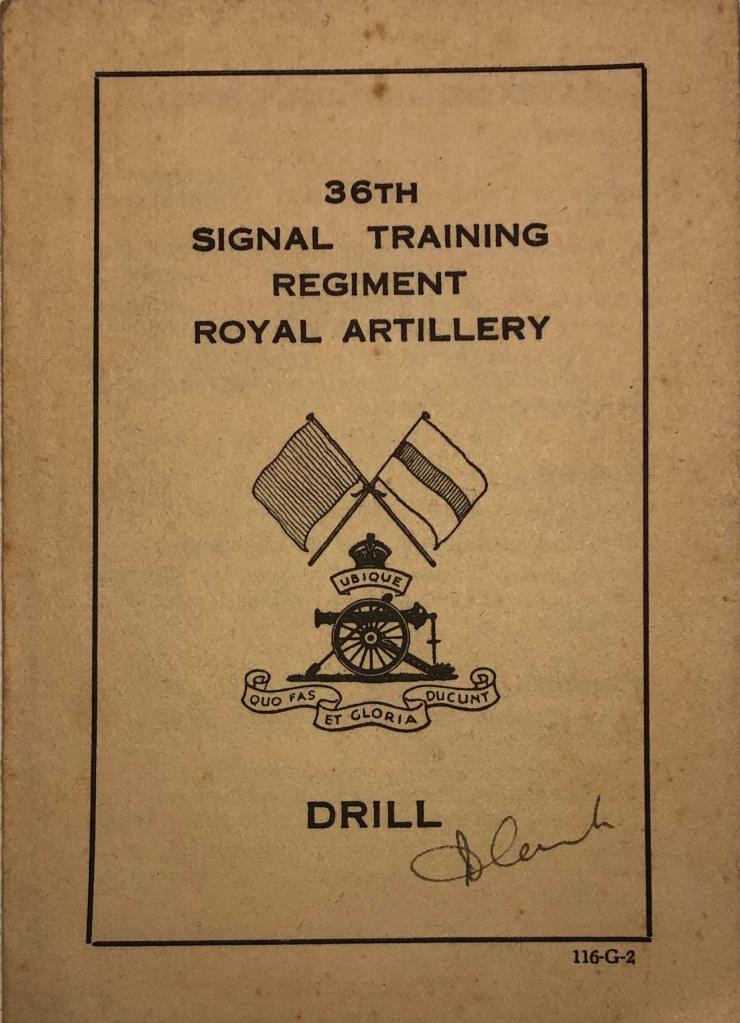
Includes:Marching, Rifle, and Gun Drill plus relevant abbreviations
Includes: The Morse Code and learning aids
All the lads were willing to learn and get preliminary training over. I was drafted to Squad 36a, most of whom were Newfoundlanders and all volunteers. They were an exceptionally friendly and likeable lot and we got on well. These boys were all far from home and some were homesick and already becoming a little frustrated at all the bull we as recruits, had to go through…
There were one or two air-raids and by the 10th of June the German Tanks were in Rouen and Italy had declared war on us – the situation was pretty grim and invasion became a reality. It was on the 12th of June that we were split up into rifle parties and given infantry training, here we did several night exercises and made mock raids on imaginary parachutists: with rifle and bayonet!
It was quite an experience to be out in the countryside and under the stars on those summer nights. The scents and sounds were extremely peaceful and the terror of war seemed far away. I remember one particular moonlit night when we put down our blanket on an open Sports Pavilion veranda, with roses in full bloom rambling almost over our faces – pleasant indeed, but I shudder to think what would have happened if any of our alarms and excursions had been for real.
” The scents and sounds were extremely peaceful and the terror of war seemed far away “
I cannot remember much about my fellow recruits though we spent a lot of time together, in fact the whole squad lived together day and night. We all slept in the same Barrack room, drilled and trained together and spent the evenings in the pubs in Colchester. Only some of their names stick: Moekler, Parsons, Walsh, Burke, Flynn, Harris, Facey, and Cochrane.
On the 12th of June I was told I was to be posted to a Survey Training Regiment in Brighton, and the following day myself and Sid Garrad were packed and ready to go. We got up about 5-30am, paraded in front of Depot Battery, then were taken to the station by car and arrived Liverpool Street at 10-30am.
Sid’s people were waiting for him and after arranging to meet at Victoria about 1pm he went off. I rang Mum and while I waited for her, went into the office at Lincolns Inn Fields to see the lads and lasses. Graeme goes to Skegness on Monday. Mum and I had lunch at the Corner House, and then I caught the 1-48pm to Brighton arriving at the Barracks in time for tea.
It was a laughable sight to see Sid coping with a heavy pack and two huge kit-bags – a friendly postman gave him some assistance. I let my kit bag roll down the steep incline from the station, it certainly gathered momentum but unlike the rolling stone gathered a considerable amount of dirt, finishing up on the London Road.
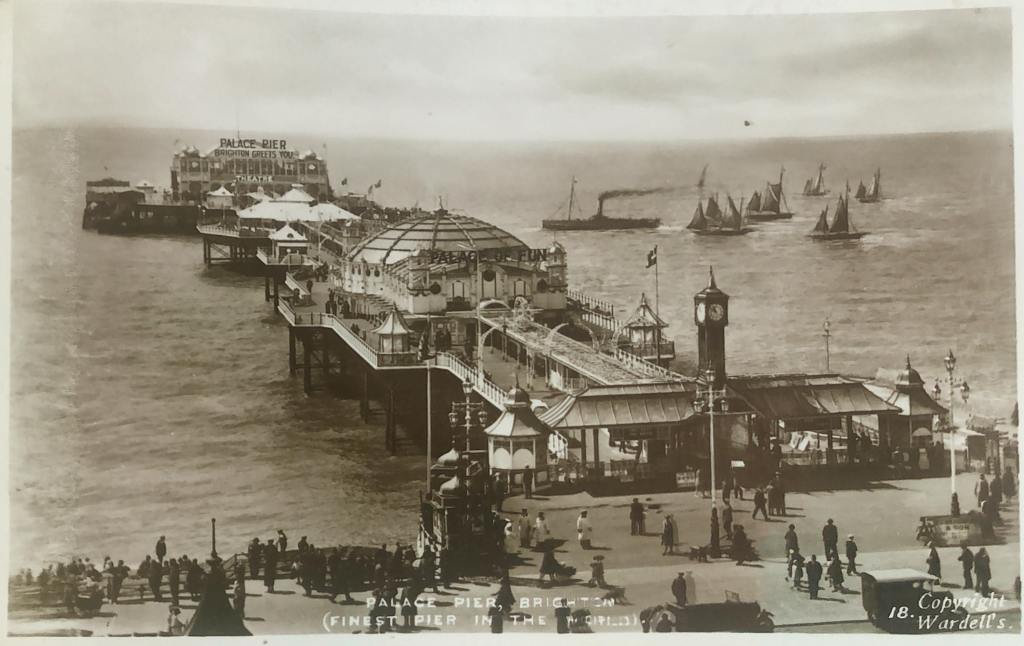
‘The Palace Pier: the finest Pier in the world’
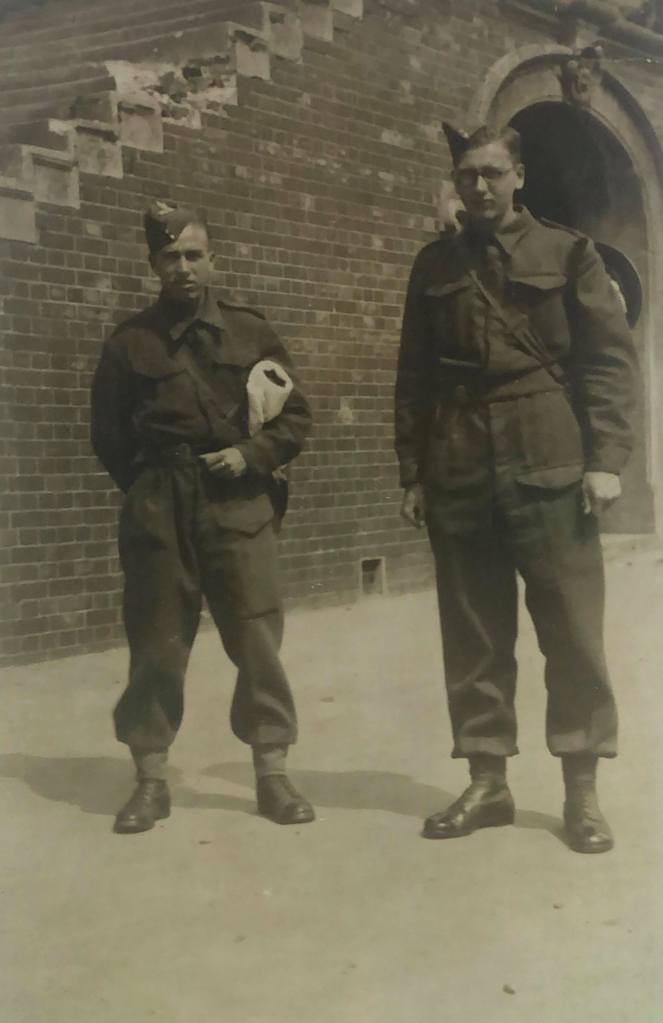
Note: polished boot toes and carrying gas mask and steel helmet with bathing things inside
On the next day after we had a cursory Medical inspection. It went like this.
M.O: ‘You all right Clark?’
Me: ‘Yes Sir!’
M.O: ‘Very well, Next please’
Immediately after this, I was picked for Guard Duty on West Pier – I was inspected and paraded, then taken down to the Pier in a lorry. The changing of the guard was apparently looked upon as something of a spectacle and the Sergeant was intent on giving the already assembled crowd their money’s worth.
The ceremony over, I could take a look at the surroundings. The original Pay Box at the Pier entrance was now the Guard House and the ladies’ toilet was the Mess. It turned out to be a lovely night: clouds scudding along calm sea, wind off-shore and the moon making silvery reflections on the water. As this was a 24-hour Guard, we had the whole day as well as the night to spend here.
Though at night there was no distraction from the sounds and beauty of the sea and sky, during the day, as the front was still open to the public, it was amusing and entertaining to see and sometimes to talk to the passers by. It was quite the usual thing to get presents of food, fruit, books etc. from these people. One old lady with a Pekingese [dog] made an anxious enquiry as to what had happened to the Pier cat… From what has happened to the Slot Machines and locks and safes, I should not be at all surprised at what had happened to the unfortunate cat!
We were relieved at 6-30pm by the new Guard and so back to Barracks.
Our days and nights for the next month or so were repetitions of Guard duties, marching drill, rifle drill, interspaced with various fatigues, and one or two alarm excursions.
One such was when I was going out on an evening pass, all leave was stopped and we were detailed to collect our rifles, and boarded a coach and driven, first to Shoreham Harbour, then to the Gas Works, on to the West Pier and then visited a Naval Battery, all in a night drive, finishing up in the early hours at an empty house in Portslade, where we all got down on the floor for a short rest, no food or drink, except a cup of tea from a kind lady in a house in Grange Road called ‘Minihaha’. Eventually we got back to Barracks to find ourselves on Guard again.
On another occasion we were taken by coach to Preston Park, where we got down among the trees for the night, but at 1-30am were told to get back to Barracks. Tempers were rather frayed that night. It started at the beginning, when a few of this Mobile Squad took longer than the quarter of an hour allowed, from hearing the signal to parade, and ending by someone putting his rifle through one of the coach windows, and yet someone else dropping a box of Molotovs, breaking the lot with petrol all over the place.
We never took these excursions very seriously, which with hindsight, knowing at the time a German invasion imminent, could have been a devastating shambles.
” We never took these excursions very seriously, which with hindsight could have been a devastating shambles “
On the 5th of July the front and foreshore were closed and we started to strengthen the shore defence with pathetic sandbagged positions, all the way down to Rottingdean. Rumours of an invasion were numerous, even that bodies of German soldiers had been washed up along the coast.
By this time there was evidence that the coast defence around here needed to be stronger than the rifles and Mobile Squads of our Training Regiment could manage. The 3rd Field Regiment came in somewhere at the back of the town, and calibrated their guns, and registered targets along the seafront. A Machine Gun Regiment went into Rottingdean, and took over our small amateurish positions in that sector.
Though there were rumours that we were going to be relieved guard duties, we still alternated with very little respite from these duties, between Palace and West Piers. We grumbled and lost a lot of sleep, but the nights, and early mornings especially, were often magic, the moon, the sea, the sun and clouds, and the wind and surf.
We sometimes did a guard duty at the Barracks. This was a prison cell of a place, and in fact had prison cells for any delinquents. Guard duty here was a claustrophobic experience. Standing outside a door under a veranda, and facing a blank wall, the only opening being a barred Wicket gate which opened onto the street.
” The nights, and early mornings especially, were often magic, the moon, the sea, the sun and clouds, and the wind and surf “
There were a few regular soldiers on this guard and it was here I came across the system of one of the guard being nominated by the Inspecting Officer as ‘stickman’. If you were awarded this you did not have to do any guard duty as such and were able to sleep all night without interruption, merely acting as runner during the day. The criterion for this award was to be judged the smartest and cleanest on parade. This often meant some regulars had a complete outfit cleaned and pressed including boots boned to the gloss of patent leather, and even the studs on the soles polished, all reserved for these occasions. Some even went to the length of getting two pals to carry them onto the Parade ground, and put them down in line with others on parade so as not to get even a speck of dust on their boots before the inspection took place.
We recruits were no match for the Regulars at this game, though some caught up very fast. However, none of us escaped having to do some spit and polish bull. The technique of using the back of a heated spoon to bone the toe of the boots with a mixture of boot polish and spittle, and eventually obtaining a mirror-like finish was an early achievement. But the bane of the week was the Barrack Room and kit inspection. First, the floor, which was wood blocks, had to be highly polished. To this end we had to collect a huge dollop of polish from the Stores, usually in a few sheets of newspaper. This had to be spread over the floor, this was then polished until it shone, with a heavy padded metal bumper. This was really hard labour. After this beds, bedding and kit had to be laid out in accordance with the official kit layout. There were no prizes for all this, but plenty of punishments if things were wrong.
On the 11th of July 1940 Mum and Dad came down to Brighton. Saw them at lunch time and arranged to meet them in the evening. We had dinner at Howards Pavilion Restaurant, very civilised and pleasant change.
Around this time, we had a spell of contrary weather, beautifully clear and sunny, with high gale force winds, alternatively rising, and the next day dropping to a mere breeze. These winds, coming from the sea lashed up the waves and at high tide, sending spray swilling and sparkling over the Pier and us, drenching the whole front. It reminded me of Robinson Crusoe’s comments in his diary, “The night before, a terrible storm, and the day following calm and sunny”. For us the significance of these conditions, was that whilst this weather lasted, invasion by sea was improbable.
By the middle of July we were finally relieved of guard duties, and our Survey training started. Also the beach and foreshore were reopened between the Piers, and on our afternoons off, several of the Squad used to go for a swim, and perhaps tea afterwards at the Mikado café on the front, where they boasted that a huge Willow patterned bowl on the counter, was always full of cream.
” The significance of these conditions, was that whilst this weather lasted, invasion by sea was improbable “
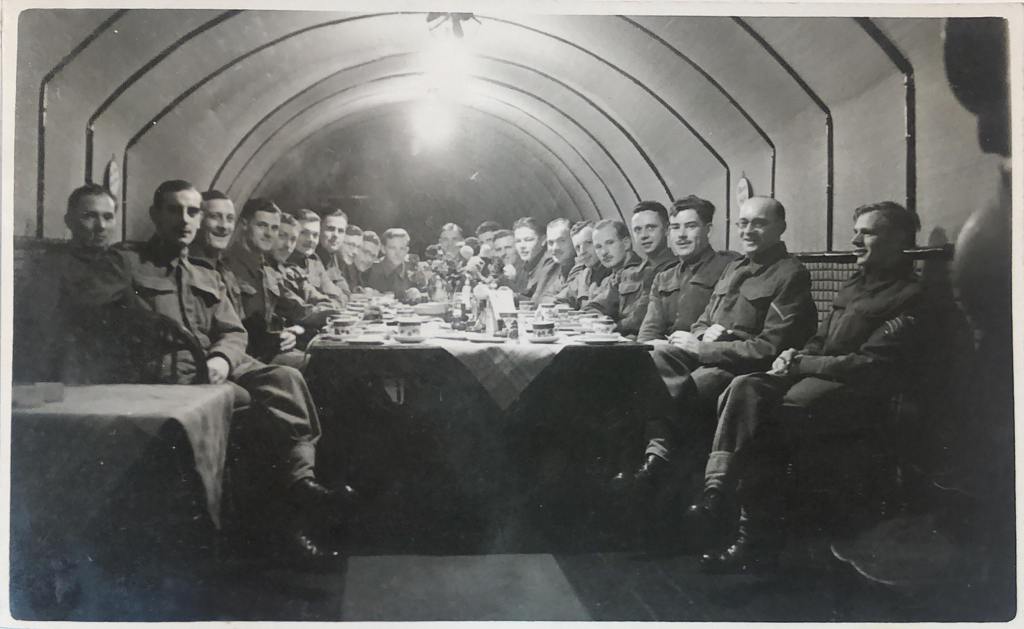
Later we sometimes went to the Arlington for some food. This was a five-star joint and even at this time, luxuries like lobster and pheasant could be ordered. It was a favourite place for our Officers, and it was amusing to see to see, at the next table, a group of new recruits who had been put on cookhouse duties in the Barracks having a complete change; and knowing what it was like behind the scenes, back there, could appreciate what a drastic change it was. They even asked for French mustard. At this time, we had three Solicitors, one Barrister and three Surveyors, in the cook house. All volunteers to join the Army.
In early August there was a lot of air activity over the Channel, and our Regiment were recalled to do beach defence again. The Piers were cut, about half way down, and we did a lot of sand-bagging both at Black Rock and Shoreham. Though we were told these strong-points had got to be built, we were not given any material, other than sandbags. Everything else had to be scrounged, even tools. One instance, where a supply of nails was required, we went to a plumbers and house decorator’s place, who we knew had lent a garden fork to us about a month previously, and had not got it back, so here is the scrounge technique: ‘We understand that you lent us a fork etc. What is is like? Any markings? Will check up on it for you, and by the way have you a few nails?’ Easy.
On the 14th of August I had an interview with the Colonel, Pring-Mills, and was promoted to Lance-Bombardier. He told me that if my progress continued he would recommend me for a Commission. On the following day the new intake was due and I was put in charge of one of the Squads, and overnight became a father figure and mentor, and looked upon as an authority on such military matters as boot polishing, correct dress, kit layout, inoculations, and drills etc.
On the 14th of August I had an interview with the Colonel, Pring-Mills, and was promoted to Lance-Bombardier. He told me that if my progress continued he would recommend me for a Commission. On the following day the new intake was due and I was put in charge of one of the Squads, and overnight became a father figure and mentor, and looked upon as an authority on such military matters as boot polishing, correct dress, kit layout, inoculations, and drills etc.
One day we had a seven-mile Route march up to Moulescoomb, Falmer, Race Hill and back. It was exceedingly hot work in the sun, and shattered some of the recruits, but the Sergeant in charge was in no mood to spare them, as when we got up onto the Downs above Falmer the Air Raid sirens were heard over Brighton, and an enemy bomber came over, the squad, thinking that they were the special target of this lone plane, broke ranks and rushed for cover. One bloke had the temerity to drop his rifle, leaving it where he dropped it, and continuing his dash. The Sergeant was livid, as he had not given any orders, and so obviously the squad had a lot to learn, as to the bloke who had dropped his rifle, he could regard himself as a criminal and could think himself lucky not to be put on Court Martial, and shot! By the time things had been sorted out, the all clear had sounded, and the plane no doubt was back in Germany.
Thank God we have a Navy.
” Thank god we have a Navy “
From the beginning of September, we concentrated on our Survey training, the routine being, half an hours P.T. before breakfast, then lectures from 8.30am to 7pm in the evening. Sometimes we would do field work, perhaps out to Stanmer Park for map reading, and other days doing a traverse, and fixing gun positions, usually up above Falmer on the South Downs. The weather was good and we enjoyed these schemes. There was a lot of air activity at this period, and we saw many dog-fights high up in the sky, where the machine-gun fire, the vapour trails, and the occasional sight of a fighter plane dropping out of the clouds, and then zooming back, engines screaming, at incredible speed, made us realise that there was a real war on.
On the first of October I heard that [my sister] Marjorie had been taken to the north Cheam Hospital with T.B., but thoroughly relieved that they say that it has been caught in time.
Spent a lot of our half-days off, at this period, playing golf at Rottingdean, and afterwards to the Black Horse or the White Horse on the front. Sometimes we got further afield and walked the South Downs from Pyecombe to Lewes. At night if you walked up to Hollingbury, you could watch the fireworks of the London Barrage.
During October the staff at this Barracks was reduced, and towards the end of the month we got the order to move. The Regiment had a special train, which took us to Amesbury, our destination being the School of Artillery, Larkhill. It was a glorious day and the countryside was at its best, it was difficult to remember we were in a war. That night we were quartered in a Gymnasium, it was a freezing place. I met Braithewaite, and we went to the Garrison Theatre in the evening. He moves out on Thursday.
The next day, the 22nd October 1940, we wandered around the camp, getting our bearings. There was nothing but Military Camps and open plain as far as the eye could see, except for Stonehenge in the bottom of the valley, looking quite insignificant in the middle distance. The scene in the early morning is unforgettable, the mist clings to the valley, and the clumps of trees on the tops of the highest parts of the rounded Downs, stand out like islands, from this sea of mist. With the sounds of each Regiment’s bugle calls for reveille, some near, some afar, you realise that you are indeed a soldier, and following the long tradition; it could be any time in history.
We were soon organised in our new quarters, and continued our training. Rounds of angles, Knighton Tanks, Bulford Clump, Umbrella Tree. First swinging right, then left, hopefully checking out. All centred on the object of hitting a target which was perhaps miles away, and was invisible from the guns.
At the end of October, I had a few days leave, and went home to Norbury, along with a pal called Field, in his car. Several of the recruits still ran their own cars. Came via Andover and Basingstoke, had a meal at the White Hart, in Andover. Arrived home just after tea-time, much to their surprise. Had a quiet night, only gunfire and distant bombs. Next day Graeme turned up, he was on leave for ‘boiler cleaning’.
Back at camp, the weather was becoming very much colder, and it was not quite so pleasant having to do surveying out of doors, all day long. However, we eventually took our Trade Test, and I think most of us passed. So we ceremoniously sewed our ‘S’ badges onto our sleeve, and were given 1/- [one shilling] a day extra pay.
Our leisure time was spent, mostly in going out for extra grub, and a lot of beer was consumed. Sometimes in nearby Durrington or Amesbury, at other times going into Salisbury. Our favourite place for food was the village hall at Durrington. This canteen was run by the Ladies of the district, and the menu here was first class, sometimes there was trout. The excellent cooking, the general appointment, and the tasteful crockery and table decorations, so vastly different from Army and N.A.A.F.I. catering, made it well worth the three mile walk across the plain, even on a rainy night. On top of this could also be incorporated a drink at the Stonehenge Inn, either on the way there, or on the way back, or both.
Our training finished we then awaited our posting to serving Regiments. During this time, I had another period of leave and went home, hiring a car to get about. Visiting Hayes for a run over the country. But I spent most of the time indoors, in front of the fire, as the weather was decidedly December-ish, and it was a pleasant way to spend a few days.
Not long after I got back to Larkhill, my posting came through, and things happened very quickly. We were even measured for tropical kit, and given Pith helmets, and a rail ticket to Edinburgh. We had to report to the 94th Heavy Anti-Aircraft Regiment, Royal Artillery.
There were three of us destined for this Regiment, Rigby, Burbridge and myself. Rig was a Surveyor with the Arnold C.C. Roger Burbidge was slightly older than Rig and I, and was a Surveryor with the Railway Company. He was a short dapper figure, with quite a sharp manner, and became known as the ‘Colonel’, but we got on very well together.
” Not long after I got back to Larkhill, my posting came through, and things happened very quickly “
We started away from Larkhill about midday on the 14th of December, arriving Crewe via Bristol, after travelling for 12 hours. Here we had a meal at the Y.M.C.A., and then caught a train at 3am Sunday morning, for Edinburgh. A lorry then took us up to R.H.Q., out of Colinton Way. Here we were given a meal, and as there did not seem to be any restrictions or duties, after tea we went out into town, and saw a concert in the Usher Hall.
” There did not appear to be any use for us Surveyors “
There did not appear to be any use for us Surveyors, and for a time we had nothing to do, and went into Edinburgh almost every day and saw a lot of films and theatre shows. Also became proficient at the game of Croquet, which we played on the lawns of R.H.Q. in Polwarth Terrace.
Just before Christmas R.H.Q. moved into a larger property in Ettrick Road, this was a large stone built mansion in its own grounds, including a tennis court and aviary. We called the place ‘The Towers’, though there was only one square central castellated tower, on either side of which were wings, each finished by stepped parapets to the gable ends: a most imposing building.
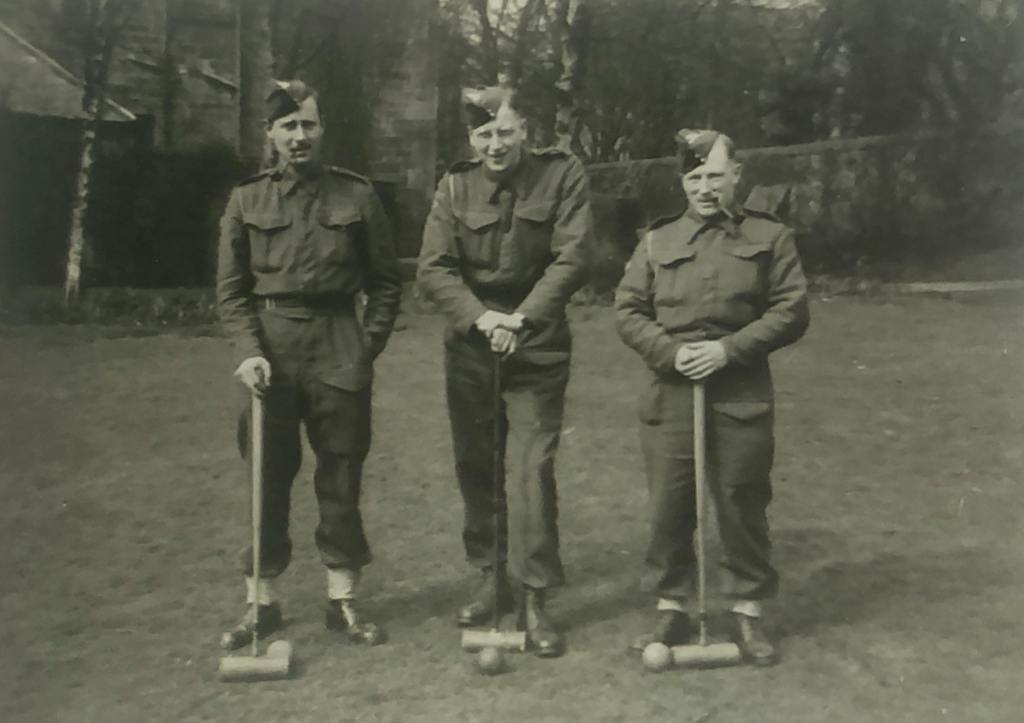
Polworth Terrace, Gilsland Road, Edinburgh
Left to right: Rig, Me, Rodger
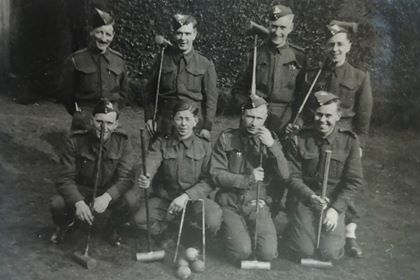
Back left to right: Collur, Dyson, Gray, B.Kellet
Front left to right: ?, Stan Brett, Wood, G.Mold (killed in Italy)
No-one seemed to know what to do with us Surveyors. This Regiment is a local T.A. [Territorial Army]Regiment, and is being reinforced before being sent overseas, and from being wholly Scottish, is now being diluted by all us Sassenachs. There is a most un-military atmosphere, as all the originals know each other personally, and their civilian status, rather than their military rank seems to count most. A we newcomers only know the army rank, the situation is sometimes amusing.
We have plenty of time to explore Edinburgh, and it is indeed a fine city. There are many vantage points to overlook the town. One place, high up above the station, especially at night, where far below the trains run in the cavernous depth, the darkness accentuates the unprotected murky depths of the cutting, full of steam and noise.
On Christmas morning, of all times, we had to go through a gas chamber, for gas mask drill, with the usual lark of having to remove our masks in the thick of it. Everyone came out with their eyes streaming with tears. At the parade after this, the Colonel wished us all a Merry Christmas, he too had tears on his cheeks. After this we all went to dinner, it was a really special spread. Turkey, and all the trimmings, pudding, sauce and mince pies. Afterwards we had a sing-song, accompanied by fiddle, guitar, piano and accordion.
We have now been with the Regiment for a fortnight, and have done nothing but eat, so it was a change to be asked to help in the Office, and take over the switchboard.
On New Years Eve 1940, everyone was given a late pass until 2pm, and we went to Town to see for ourselves, how the Scots observe their festival. We had a few drinks at several pubs, but it started to snow, and within half an hour there was a layer at least two inches thick. Trailing between pubs wasn’t very pleasant, so decided to go to a dance at the Palais.
” On New Years Eve 1940, everyone was
given a late pass until 2pm “
When we got there it was crowded, and several of the natives were already under the tables. The floor got increasingly crowded, so we went up on to the balcony for an ice. What a sight it was from above, a seething mass of bodies. If these had been birds or insects, we should have assumed that they were about to swarm or migrate; perhaps true of people too, as we were expecting to go overseas at any time. A running scrap developed on the dance floor below, a sailor put up his fists, and engaged a soldier to fight. The soldier didn’t take much egging on, because he took a hefty swing at the sailor but missed altogether, and before he could recover his balance, some other bloke caught him a beauty on the chin. The mediators entered in at this point, and held the contestants apart, but they broke away, and the last I saw was a struggling heap on the floor. After the dance we made our way back to the R.H.Q., through the snowdrifts. What a tousled, bleary eyed lot came down to breakfast the next morning.
For the next four months our routine was pretty boring, we did a few drills, and worked in the Office. Us Surveyors gave one or two lectures on Map reading to the Battery lads, we also did fire-watch duties in Napier Road. On one occasion I was roused by the fire brigade to inform me that the chimney was on fire. We spent our evenings in Edinburgh, at the cinema or a theatre, finishing up in some bar or café. Our guns were only in action twice in all this time.
We went on two or three long route marches of up to 12 miles, during these winter months, on one occasion were given raw meat and had to cook our own meal out in the open. It was a dreadfully cold damp day, and the only thing we could find to burn, and make a fire was some old roofing felt, which gave off such dense obnoxious fumes, that the meal was uneatable, and we smelt for days. Another time, the entire Regiment did a ceremonial Church Parade, down the whole length of Princes Street, two bands in attendance.
During this time, I had two leaves, the first was on the 14th of January 1941.
I left Waverley Station on the 5-18pm, and arrived in Newcastle at 8pm, but as I could not get a connection until 11pm, I rang Arthington to tell them not to wait up (it had been arranged that Mum and Dad would come up to Arthington, to meet half way).
I went out of Newcastle Station to look for somewhere to get support, asked an Old Boy who was standing around, he conducted me through the Blackout, down alleys, and small streets, then through a Newspaper Office and down into a Salvation Army Canteen, stayed there for a couple of hours, then went back to the station to catch the York train, this left on time and I then had a comfortable journey, as I was able to lay full stretch being the only passenger.
Changed at York, and had a cup of tea, and was able to catch the 1-55am Leeds train. It turned out to be a brilliantly moonlit night, a white frost seemed to illuminate the whole landscape. So I put out the lights, and opened the blinds, and watched the passing countryside. At Leeds I managed to get a good breakfast, and as the train for Arthington did not leave for another hour, decided to walk.
I started out across the moonlight City Square, continuing past the familiar buildings and traffic lights, and the ghostly white façade of the City Hall. It was so quiet, that the ticking of the clock up in the tower, could be clearly heard. Continuing past the University, across Woodhouse Moor, and on through Headingly, out into the Otley Road. Finally, on to Bramhope, turning into Creskeld Lane. Here again it was so quiet, that could hear the trains going into the tunnel, or perhaps the sound came up one of the tunnel air-vents. Arrived at the Post Office about 6am, and surprised to find Aunty Dot up and about.
Later in the morning I went round with the postman. Lovely scene from Bank Top across Riffa, to the fold in the hills at Fewston, reminding me of the times I’d been up here with Uncle and longer ago with Mr Chambers.
In the afternoon went into Harrogate, where I had arranged to meet Aunty for tea, I had to ask the way from a chap, who after telling me in great detail the way I should go, I had a lot of difficulty getting rid of. He told me that he was always showing people the way, and how easy it was to get lost in Harrogate, and that he knew seven ways, all different, to get to Knaresborough. He said that if it had not been for him, one lady, who was looking for the Post Office, would have been in Skipton by now.
I visited Eric’s parents at Almesford Avenue. It snowed heavily at night, but I was able to catch a bus back to Pool [Pool-in-Wharfedale].
The next day I went into Leeds and hired a Morris 8. From the size of the advert for this garage, I expected to find a big firm and a huge garage, but it turned out to be a one-eyed place, in a squalid part of Meanwood. Anyway, managed to get five gallons of petrol, and went off to Wakefield to see out old neighbours. I left Brook’s about midnight, and came back via Tingley, arriving back at the Post Office at about 2am. Once again Aunty Dot was still up. This time to tell me that Mum and Dad had arrived and that I had to sleep in the sitting room.
The following day took Mum, Dad and Aunty Dot for a ride round by Leathley, Buryemwick, Fewston, Norwood Edge and back via Ilkley. Dad and I climbed the Cow and Calf and then had tea at the Kiosk Café. The next day wasn’t such a good one: bitterly cold and a blizzard blew. Had to get the P.O. van to give me a tow to start. However, took everyone into Leeds, shopping. On Sunday the 19th of January, Dad, Mum and I had to return, snow had fallen all night, and it was lying in drifts, three to four feet deep. It was hard work walking to the station. Mum and Dad caught the London train at Holbeck, and I saw them off in the crowded, steamed up apartment, whilst I caught a train back to Edinburgh via Newcastle.
My last leave before going overseas, was on the 24th March. I arrived in London at 7.30am and wandered around the streets, having breakfast in Lyons in the Strand, afterwards I went on to Norbury. Mum and I went to Croydon; Kennards for lunch, and then to the pictures. One day I hired a car, and Mum and I went to visit Marjorie who was still in Cheam Hospital, and took her for a drive. We went to Box Hill, then back to Epsom for tea. The next day, Dad got the day off, so we went over to Tattenham Corner and walked over to Headley, having lunch at the Cock. The parrot was in good voice: Question: What is Hitler then? Parrot: A silly old bugger.
” Mum and I went to visit Marjorie who was still in Cheam Hospital, and took her for a drive “
On the 27th of March I returned to Edinburgh. Some Saturdays we used to go to a football match, and we saw Hibs [Hibernian] and Hearts [Heart of Midlothian], and Clyde, also witnessed the Semi-final of the Scottish Cup, which Hearts won, beating Celtic. There was plenty of cup-tie fervour from the spectators, and beer bottles were thrown at the wingers throughout the match.
On the 27th of March I returned to Edinburgh. Some Saturdays we used to go to a football match, and we saw Hibs [Hibernian] and Hearts [Heart of Midlothian], and Clyde, also witnessed the Semi-final of the Scottish Cup, which Hearts won, beating Celtic. There was plenty of cup-tie fervour from the spectators, and beer bottles were thrown at the wingers throughout the match.
At the end of April the Regiment packed up all its equipment, and we of R.H.Q. joined the convoy to the Glasgow Docks. We Surveyors were detailed as machine gunners as A.A. defence, and manned a Lewis gun attached to a precariously fixed bracket on one of the lorry tops. We had trouble starting, and so got left behind. Even the Colonel had a go at swinging the engine, eventually got going, and soon caught up with the rest of the convoy. We arrived in Glasgow at midday, right at the busiest time, but we had a Police escort, and just whizzed through the town, passing the towering red brick Grandstand at Ibrox Park, then on to the docks. There were tanks, planes, lorries, quite an astounding sight.

Surprisingly we left our vehicles, and returned to Edinburgh. A few days later all the Regiment returned to Glasgow by special train, and immediately went aboard a tender at Gourock, and climbed aboard the S.S. Aronda (10,000 tons), which together with other Troop Transports, was anchored out in the Clyde.
What a confused crowded place the Troop decks seemed to be. The first job was to collect our hammocks. What a game ensued when in the confined space, we tried to hang them. However, order was eventually brought about, fortunately we lay at anchor for three days, and by that time, we were familiar with the ship and routine.
We set sail at 8.10pm on the 26th of April 1941, it was getting dark and by the time we had cleared the boom, the detail of the coast had disappeared, only the outline of the hills were visible. Out to sea, the wind freshened and it became too cold to stay on deck. We went below, full of apprehension as to the voyage, remembering too well the possibilities of U-Boat attack.
The next morning, we went on deck, to a very cold, grey looking North Atlantic scene. The convoy comprised about twelve ships. Four were large liners, obviously Troopers, the rest Merchantmen, and two Destroyers, and were spread out in three lines, sailing on a predominantly westerly course.
We continued in this direction for the first week, and we all thought we were going to hit America. Everyone spent a lot of time looking over the rail, keeping a sharp lookout for signs of Submarines, or bombing Planes. Towards the end of the week the sea got rougher, and I succumbed to sea-sickness. A really miserable feeling, you just want to be left alone. I was not the only one, there were quite a few solitary huddled figures, squatting in out of the way places around the deck, with the occasional dash to lean over the side. The sight, or thought of food was enough to bring on the nausea, especially as the Mess Decks were in the forward part of the bows, and in a rough sea, there was a terrific rise, and sickening fall as the ship breasted the waves.
On the 2nd of May the sea became calmer, the sun shone, and we started to sail a southerly course, this made us feel much better.
The next day the convoy split. We continued South. It was rumoured that the other convoy was bound for Gibraltar, and history now confirms this. Five ships of the original convoy, containing a large reinforcement of tanks, was diverted through the Mediterranean, to make a dash for Alexandria. This was largely on Churchill’s initiative, after receiving a telegram from Wavell, stressing the gravity of the situation, owing to Rommel’s Offensive, which had taken him up to the Egyptian frontier.
” Our first sighting of land for twelve days “
The weather became consistently better, and on the 4th of May we changed into K.D., and started sleeping out on the Shelter Deck. Fortunately, we hung our hammocks in the roof of this covered deck, because; though unknown at the time, lascars used to swill the decks down, very early in the morning, and for those who elected to lay down their hammocks on the actual deck, it came as a rude shock to find water lapping around them, as only then did the Lascar, hysterically shout the warning, ‘Water come Sahib’.
The dim outline of land appeared at about 6am in the morning of the 9th of May. Our first sighting of land for twelve days. The land got closer, and mountains and jungle came into focus, we were soon anchored in the bay, about a mile offshore Freetown. The ship was immediately surrounded by natives, in narrow, dug out canoes, selling fruit, and diving for pennies, which when thrown over the side, could be plainly seen gently sinking through the clear sea. Most of the natives spoke English, apparently they cannot leave school until they have reached a reasonable standard.
The ship was here to get its coal-bunkers filled, and it wasn’t long before the coal barges came alongside, also bringing the coaling crew. These lads were an amazing sight, a hell of a motley ragged bunch. The first thing that struck us was that they all wore caps, of eye boggling variety, from floppy carpet material ones, to school boy caps. The latter were by far the most popular, and looked the most incongruous. Some had cap badges, and several had crossed cricket bat designs. After the coal-barges came alongside, two gang planks were fixed up from them to the deck. Then all day long, through the tropical heat, about thirty natives brought up a load of coal on their heads, running and emptying it down a shoot on our deck, and then down the other gang-plank and so on all day, with only a break at 2pm, for a bowl of maize. The heat was terrific, coal dust all over the place, and even at the end of the day, were still a smiling yet extremely dirty crew.
” These lads were an amazing sight, a hell of a motley ragged bunch “
After the extreme humid heat of the day, the evening was delightful, and as it got dark, the lights ashore came on, and you could see car headlights picking their way along the coast road. During the night there was a severe electrical storm, terrific lightning but no thunder. Eerie sounds came from the nearby jungle, and screaming noises, which we believed to be gorilla calls, could be plainly heard.
On the 14th of May we left port, and during that day’s sail, passed close to a half submerged life-boat. It was empty but had a jury mast, with an old vest attached to it. The fate of its occupants gave us food for thought.
We crossed the line at 6.48am on 16th of May 1941. To pass the time, Rig, Ridge and I started carving a set of chessmen from some apple box wood, this would keep us amused for a while. It is fascinating to watch the flying fish, the wash of the ship seems to frighten them, and when so disturbed they fly about thirty yards, and then dive back into the water. They cannot vary their height when once launched, as when a higher steeper wave comes along, they flop straight into it.
I have been in the Army one year on the 16th of May. It has really been a holiday so far, but a lot of wasted time. These days are spent reading, looking over the side and eating and sleeping.
We have now finished the chessmen, and they don’t look bad at all.
” Passed close to a half submerged life-boat, the fate of its occupants gave us food for thought “
We kept sailing South, and on the 20th of May changed back into Battledress, as the further South we travelled it became much chillier. The Plough constellation is still visible, and have now caught sight of the Southern Cross.
Had further inoculations, and didn’t feel so good for a day or so.
On the 25th of May we ran into very heavy weather, we estimated that we must be somewhere near the Cape. The wind increased to gale force and the seas became mountainous, spray came hissing over us from each wave crest. We were allowed up on the Promenade deck during the day, and had to hang on to life lines stretched to the full length of the decks. The view was superb, though the scale of it overawed us all. The other boats in the Convoy were plunging about, one of them showed her propellers every time she dipped over one of the gigantic waves. The seas calmed down during the night, and from that time on it started to get warmer again the further we sailed Northward and back towards the equator. Some lovely yellowish sunsets, and we got a glimpse of Table Mountain, low down on the horizon as we rounded the Cape.
By the 27th May we were in Durban and were allowed ashore almost as soon as we had docked. The ship was tied up alongside a palm fringed promenade, with white skyscraper buildings all the way along the seafront.
At night the place is brilliantly lit, coloured neon and fairy lights, enough light to read by. Food and fruit are in abundance, Rickshaws were everywhere. The natives who pull these, act like horses and shake their heads, and paw the ground, and prance up and down, to attract your custom.
Had our first drink of iced beer in the Twines Hotel. Then visited one of the many free Canteens. One of the girls took three of us to her home for supper. Her father was the Harbour Master (Pirens). The family entertained us to a meal, and we left just before midnight. As we approached the ship, what a scene! Like the retreat of a beaten Army. Some carrying a pal, or one helping the other, most of them tight as Lords. To the majority of them it must have seemed an almost impossible task to climb up the steep gang-plank, as the ship’s side really towered up sheer form the dockside. When we got onto our own deck, it was chaos, some being sick, some wanting to fight, others shouting and singing. It wasn’t until about 2am or 3am that things quietened down.
Next morning there was a route march, up and down the sea front. Rather a strange experience after our five weeks at sea. After this we went into town to the Royal Automobile Club, where we were split up into parties and the members took us out in their cars. We went with a Mr Taylor, who had originally lived in Portobello [in Edinburgh]. He took us out into the hills, stopping for tea in a delightful café. He then showed us the source of the Umengi River, then back to Durban via the beach. Afterwards we had a meal at the Playhouse Grill.
” Watching the dark velvet sky, with its numberless stars gyrating gently with the motion of the ship was and still is a magical memory “
After this pleasant few days we left Durban on the 31st of May, and sailed steadily Northwards, the weather getting hotter all the time. By the 10th of June we passed a group of barren islands, and even the wind was hot. We saw sharks for the first time, and could see their dorsal fins cleaving the sea. It was whilst we were cruising these equatorial waters that we spent unforgettable nights sleeping under the stars, on the top of one of the hatches. The Southern Cross was now plainly visible in the south east, and conjured up in the imagination the vast space of oceans across half the world.
Lying there on my back, and watching the dark velvet sky, with its numberless stars gyrating gently with the motion of the ship, indicated by the movement of the mast, the only sound being the breeze of our passage singing in the ships rigging and super structure, was and still is a magical memory.
On the 10th of June our table was awarded the ‘Cake of the Week’ presented by the Captain each week for the smartest and cleanest table. The system was that every day, after meals, all the utensils had to be cleaned and polished, then laid out on the table for inspection. This entailed quite a lot of work each day, as all the utensils used to bring the food from the central ships kitchen, for the ten men on each table had to be scrupulously cleaned, washed and polished. It was rather a nice fruit cake, but hardly worth the labour.
The 11th of June found us sailing a North-Westerly course, and we knew we were getting to our journey’s end, and on Friday the 13th of June we arrived at Port Taufiq, at the head of the Gulf of Suez. It was a flat sandy place which smelt of oil, and was full of shipping. The next day we disembarked, and were glad to get on solid ground, however dusty and hot.
We boarded a train: grey, windowless, wooden seated carriages, and were soon in featureless desert. The glare from the sand was terrific, and we were thankful when the line ran into the more fertile delta plain of the Nile. We eventually arrived at our Camp, which was on the outskirts of Cairo, and Beni-Yousef, right on the edge of the desert, within sight of the Great pyramid, at Mena.
” Our first visit into Cairo was a fascinating experience “
The camp was well off the Mena – Cairo Road – along tracks which followed the irrigation ditches, in a straight line for mile after mile. We passed native farmhouses where everything was very primitive: wooden ploughs, and water raised by Shaduf [hand-operated device for lifting water] in skin bags, in biblical fashion. Our tent was on the outskirts of the camp, and it was quite a strenuous march, through soft sand to the cook house. The food wasn’t so good: bread as hard as a board, baked twice, once in the oven and again by the sun, and liberally covered in dust and sand.
Every day we marched out across the desert. To get us acclimatised? It certainly made us sweat! However, Cairo was only a few miles away, and on our half-days off we made a bee-line for one of the many canteen and bar restaurants.
Our first visit into Cairo was a fascinating experience. The crowded narrow streets of the older quarter, and the strangeness of the dress and types of people. All the signs and street names in undecipherable Arabic characters, and the constant chatter of foreign tongue, all to be taken in.
We of course, by our pale skins, and new to the country were the prime targets for the innumerable street vendors and boot blacks [shoe shiners], who pestered us all the time. Even in crowded buses, they would crawl between the legs of the crowd, and appear before you asking you if they can clean your boots. Another trick was for them to slap a large dollop of messy black stuff on to your boots, and then you were forced to let them clean it off. We soon learnt to keep them at bay.
I put my name to a message, on the notice board at the Y.M.C.A., to contact Eric, who I knew was out here somewhere. At the end of the first week, on the 21st of June I had a reply from him. He is apparently out at Heliopolis, where we met, and had a good evening together. This was the first of many meetings, and had some enjoyable times drinking, eating, film, going on visits to the cabarets.
Our acclimatisation continued with route marches, and during this time we made a complete Survey of the camp and drew up the map. Our only measuring device was a home made chain, made of string and marked every ten feet, crude but effective.
” I put my name to a message to contact Eric as I knew he was out here somewhere “
We visited the Pyramids and the Sphinx and Mena and were shown the tombs, some of which were still being excavated. An old Dragoman [interpreter and official guide] took us into one of the Pyramids, and soon as he got us into the dark passage and we depended on the light from his candle, he demanded his money. We continued up a vast staircase, just like a Central Line escalator. Arriving in the Kings Chamber in the centre of the pyramid, the old boy, for a further few piastres [coins], lit a piece of magnesium ribbon, with dramatic effect.
After this we got a lift into town and had a swim at the Y.M.C.A. and after a few Zibibs [local Anise-flavoured spirit], returned to camp on one of the crowded Mena trams. These trams were single deck and ran along their own track alongside the road. For everyone who paid a fare, there were fifty who avoided doing so. The locals would clamber up the back and on to the roof, or just cling to the outside with one foot on some projection. This was a hazardous business, as sometimes when the tram got onto a very fast stretch of the track, the conductor, to discourage the practice of free rides used to lean out over the side and flail away with a cane hitting anyone within reach, as often and hard as he could, until the tram had to slow down to a speed, when his victims were safely able to jump clear.
Bad news from Oscar Hoskins who tells me that Lou Raphael had been killed.
Life for us continued serenely, we visited Cairo for food, a film and lots of drinks and ices. This went on for weeks, a constant round of entertainment.
We continued sightseeing too and one day a party of us: Stan, Brett, Rig, Mackintosh, and Inkster climbed the great pyramid, the one which has no facing stones on the summit. We approached from the unfrequented North corner. Here the blocks are in a crumbling state, but we managed to scramble upwards. Looking back from about half way up the height and our exposed position was quite alarming, it seemed decidedly steeper than expected and looking upwards at the top seemed to overhang. The summit, when reached was an area about thirty feet square with a flag staff in the middle, and the flooring stones are covered in names, carved on the surface of the soft sandstone. The view is huge, right across the Nile Delta, to the purple desert beyond. The line of cultivation is abrupt, no intermediate zone, the desert sand just starts and the greenery ends. The roads and drains appear as on a map and most of them are straight for miles. The descent was worse than coming up, and were well jolted by the time we got to the bottom. Each of the layers of stones, like huge steps each one being four to five feet high. Whilst we were up on the top, a light plane came buzzing round, to our amazement on one circuit it was lower than us, and we could see the top of the wings.
” The view is huge, right across the Nile Delta, to the purple desert beyond “
At last we got the order to move and on the 20th of September we moved up the desert road to the north, nothing but sand and heat haze. Crossing a belt of salt marsh, where the water appeared pink, we got our first glimpse of the Mediterranean. After two days travel we reached our camp at Ras-Hawala. A super place almost on the beach, among the sand dunes in the crook of a small bay, the flat curve of firm white sand ideal for bathing. The camp is approached from the road by a twisting track through the low stiff vegetation of the flat salt marsh. We spent the next ten days bathing. First dip 6am, the last at 8pm in the dark, beach-combing and eating.
The Surveryors’ duties here are on the Bren Gun, which we take in turns to man from dawn to dusk. Two rather unusual occurrences happened here. On the 23rd of September it rained like hell for a time, and the second, was that one day the sea was exceptionally rough, with great waves bashing up the beach. One of these turned me over and threw me up the beach, painfully sand-papering the skin off my backside. I had to have it pained with iodine. The medical Orderly thought himself some great artist, putting the finishing touches to some masterpiece.
” We got our first glimpse of the Mediterranean “
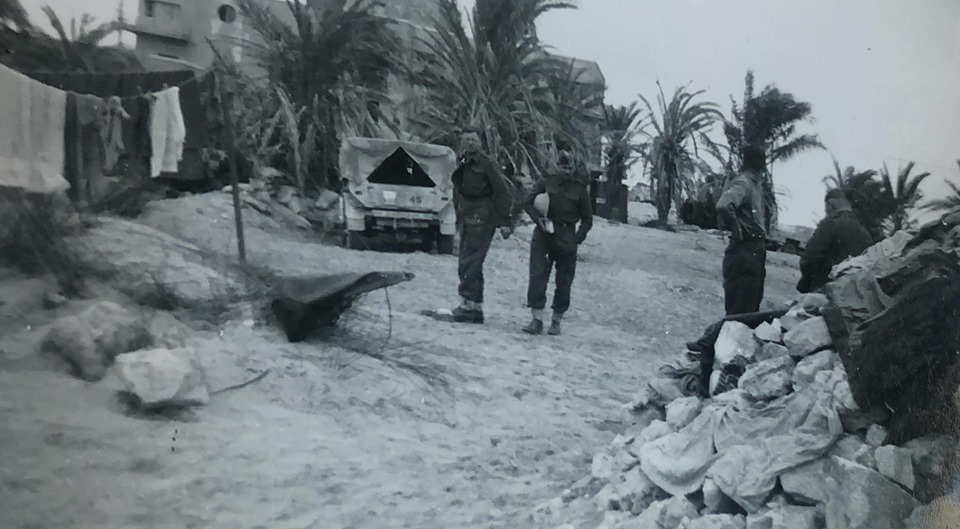
On the 4th of October we pulled out of this delightful spot of dazzling white sand and perfect blue sea with some reluctance, and travelled West, following the coast to Mersa Matruh. We settled in a Hotel right on the beach – The Lido.
The first task here was to build ourselves a dugout with a sand-bagged roof. Our stay here was short lived because on the 10th of October, Roger, Rig and myself were sent to separate Batteries. I was allocated to 261 Battery, somewhere in the desert near Sidi Barrani, and was put in one of the gun sections and on my first day we fired at a Jerry plane.
On the 11th and 12th we were again in action and fired eight rounds at single raiders, at extreme range, our shooting wasn’t too good. Had one nasty moment when one of the rounds fell off the ramming tray as Tex was about to ram it home. I picked it up, and at the second attempt it went home and was fired. It could have been a disaster.
A day or so later we had a dust storm which lasted about three days, and was really trying and most uncomfortable. This sand was particularly fine, and we had both the time and quantity to analyse it, finding, rather to our astonishment, that it contained far more than sand. There was a fair quantity of vegetable matter as well as parts of insects. This dust got everywhere, in your tea, clothes, tent, bed, nose, and eyes and stained everything a deep reddish ochre colour.
” On my first day we fired at a German plane “
On the 15th we took the guns out of action, ready to move and worked well into the night. The desert dust still blowing and no water to spare for washing. The next day the order to move was cancelled and all the heavy work entailed in putting the guns back had to be done again, in spite of the dust still blowing, and during this time there was a heavy shower, so that before long we had a paste of sand and water all over us, adding to our discomfort. But three hours later we had to take the guns out again, and at 1am we moved off into the desert, over very rough country, no tracks. We eventually kipped down for a rest but no hot food available, our only meal that day was breakfast when we had tea and hot porridge.
On the 17th of October we got into our new position. I don’t know how it was decided upon, as all that is to be seen in every direction, is the horizon, otherwise just featureless desert.
Within an hour of getting here, we opened fire. It took us a whole day of hard labour to dig a gun pit, as the desert is a rocky terrain.
Water and rations are short, and no chance of augmenting them in this wilderness. The bread, by the time we get it is dried out and the outside encrusted with sand and dust, which means that the outside slice has to be taken in turns, as one loaf has to be divided between the eight of us in the gun team.
One day, I went on the 15 Cwt Ration wagon to the aerodrome we are defending. All Fighters, Hurricanes and Tomohawks. All have shark teeth painted in the front of their fusilage. The guns were in action every day. One day, Jerry [German] fighters staffed the dome and we on No. 4 gun got 11 rounds off. First time we were given the order to fire independently, without the Predicator. The was because enemy planes came in low from many directions at the same time. We were told off for firing too low, and almost over the top of No. 1 gun, but pleased with ourselves for getting off more rounds than any of the other three guns.
The nights here are exceptionally cold, and we look forward to the warming brew of tea when we “stand to” at dawn.
Owing to our remote position it was difficult to get stamps for our letters home, I only managed to get one from a visiting R.A.O.C. driver during the last week. Water is also short and has to be made full use of, the ration is two pints a day, what remains after drinking we 1. Wash teeth 2. Shave 3. Wash face 4. Legs and feet 5. Towel 6. Socks.
” Unexpectedly, I was sent on seven days leave “
On the 30th of October we were peacefully resting at No.4 gun, when I was told to pack up my things, and taking to B.H.Q. to do some map drawing. I used the Major’s Staff car as a drawing Office, as it had a fold down table in the back. At night the Major’s driver (Dick Foley) and I used it as a sitting room.
A strange thing happened at this site. Dick took the Major out one day and it got pitch dark before they got back to camp, so dark that they could not see a thing, considered themselves lost and parked for the night. Next morning, they found themselves about a hundred yards from the gun site. This speaks well for the full-site blackout discipline, the quietness, and the camouflage.
Unexpectedly, on the 14th of November 1941, I was sent on seven days leave. Bounced and shaken over fifty miles of desert to Matruh and from Matruh and Cairo by train. As soon as we arrived we were surrounded by hotel touts. We decided on a hotel in Opera Square.
Met up with Eric at Heliopolis.
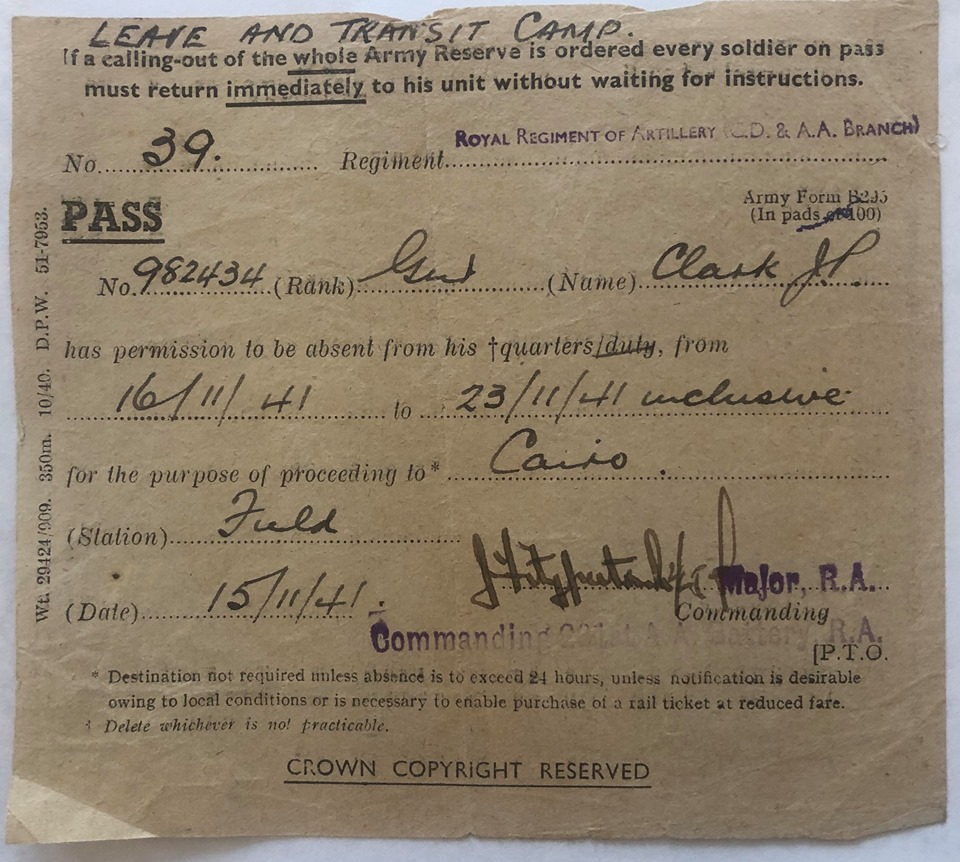
Operation Crusader started on the 18th of November, and news of our advance trickled through to us even in Cairo. Didn’t relish the journey back after this leave, as I had developed a bad head cold, so bought half a bottle of whisky for the journey. The train was packed and so had to sleep on the floor, with someone’s feet dangling over my face, I was thankful for the whisky. It was still an uncomfortable trip and was glad to arrive at Mersa Matruh after 19 hours on the train.
Just as I was leaving Matruh with the rest of the Battery lads, I was told to get off the lorry and report back to R.H.Q. I did this with mixed feelings as didn’t think it would be the same as before. However, a few of my old pals are still here and it is certainly an easier life. So it proved: we were bathing every day though it was almost December.
Now that I was back at R.H.Q. there was still nothing specific to do and I used to go with Stan to the water point each day to fill up the water tank on the 30 Cwt Bedford. This truck was nicknamed ‘Waltzing Matilda’ as at high speed the water used to swill about, making the truck swing and sway all over the road. The trip to the water point took us along a deserted coast road, and as we went along we used to fire at the old milestones and road signs, or the post on which they once stood, and they were soon riddled with bullet holes. At this time we acquired a captured Italian Motorcycle, and tore round the town for fun.
On the 6th of December we had an Air raid. Also today a German General prisoner arrived, and our Colonel had to escort him to Cairo. When he came off the ship here, he only wore a shirt and as he got into the car even his balls were visible. He had been torpedoed and picked up at sea apparently.
Our easy life continues, nothing much to do but wait. We gather in the dugout every evening and yarn and cook a supper on a Primus, our supplies kept in a secret place under one of the stairs down to the dugout. On the 19th of December we get news that we have taken Derna and, on the 22nd a captured Jerry [German] mark 11 came through. Painted with greetings for Christmas from the VIII Army, on its way to Cairo, as a present to General Auckhinlech.
” Christmas Day was gloriously sunny “
Christmas Day was gloriously sunny and we had a bathe. Dinner was stew but the pudding proved to be the real thing. Quite a lot to drink, this led to arguments between the English and Scots. Bottles were thrown and Woody knocked huge lumps off the Canteen counter.
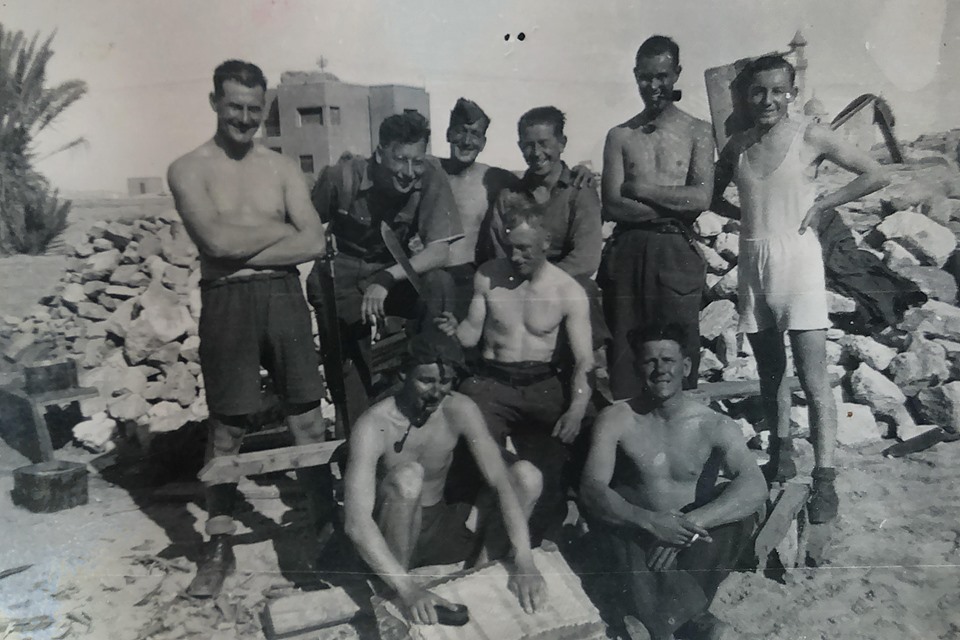
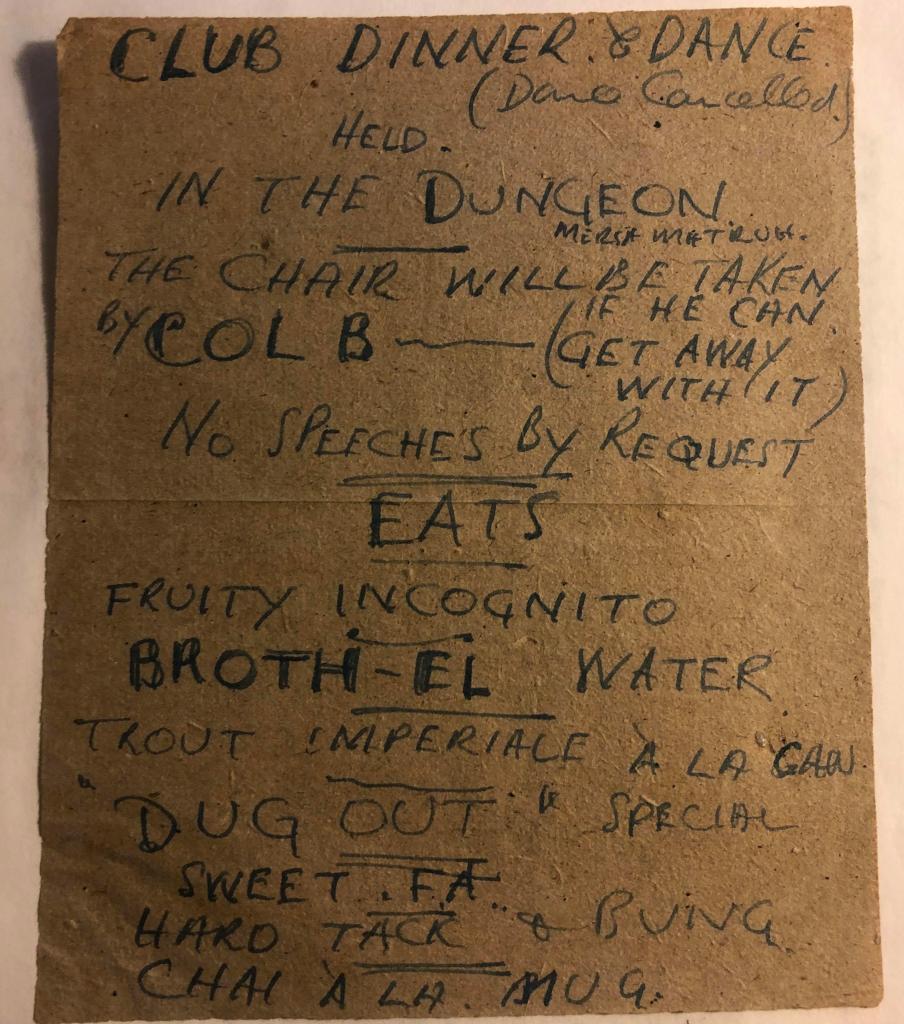
On the 29th of December we were all ordered out on a three-mile route march, some effort to get rid of the Christmas hangover, no doubt.
New Years Eve came along and ugly scenes ensued, after the drink had taken effect. We adjourned to the dugout for a private party and saw in the new Year with a bottle of Port and slices of cake, supplied by Rigs parcel from home. I thought I’d be clever and take advantage of the noise and drinking, to make a raid on the cookhouse to get some spuds, but I ran into a post and split my head open, so went to bed but not to sleep as we had drunken visitors until 3am.
We were also asked to put up a visiting Sergeant in the spare place in our dugout, but he didn’t stay. We later learnt that he had gone back to the R.S.M. and said he wasn’t going to sleep in the place because there were potatoes in his bed. Apparently the R.S.M. took it that he was suffering from D.T.’s, but the joke was that this Sergeant was the only sober bloke at R.H.Q. that night, the potatoes were real, in fact the ones I’d raided from the cook house. The next morning, as seems usual with this Scottish Regiment, nobody was fit for anything, even at 9am there was nothing stirring in the cook house.
” We saw in the new Year with a bottle of Port and slices of cake “
The weather turned pretty cold and some rain fell, but the scene on a moonlight night was glorious. Especially from the machine gun post on the Lido roof, a converted water tank, well sandbagged. From here we have an uninterrupted view across the bay and over to the high white coastal dunes. Still cooking suppers, and have now made an oven. We have also rigged up a huge canvas sheet in an experiment to catch rain water.
A South African concert party turned up, it was a real fight to get in. The girls were greeted by noisy wolf whistles which never died down. One act was by three acrobats, but owing to the very low arch over the stage most of the best action was out of view, above the top of the curtain. At this period, we Surveyors were in charge of the Armoury and took it in turns to sleep over in the cellar of the Hotel, where our small arms and ammunition were kept.
” The scene on a moonlight night was glorious “
Another of our projects to pass the time was the opening of the only Golf course in this part of Africa. The clubs were home made from date palm branches, and the balls were cut from solid rubber. There were no greens, as such as sand was everywhere.
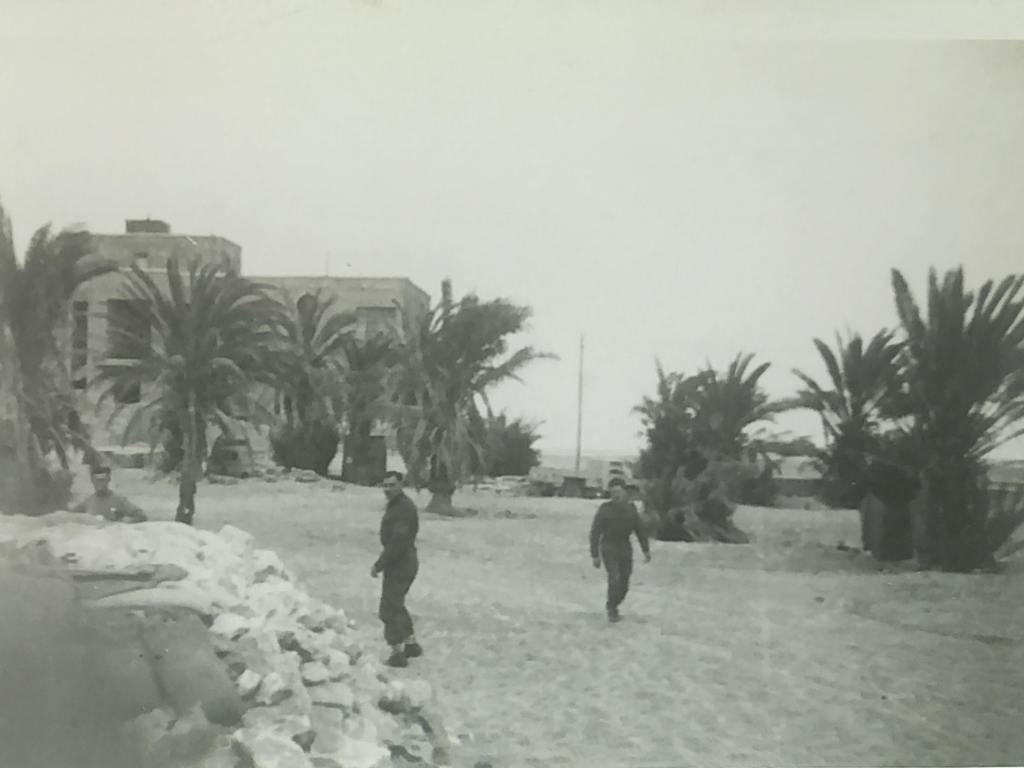
Note: Machine gun post on roof and our reinforced dug out in bottom left corner
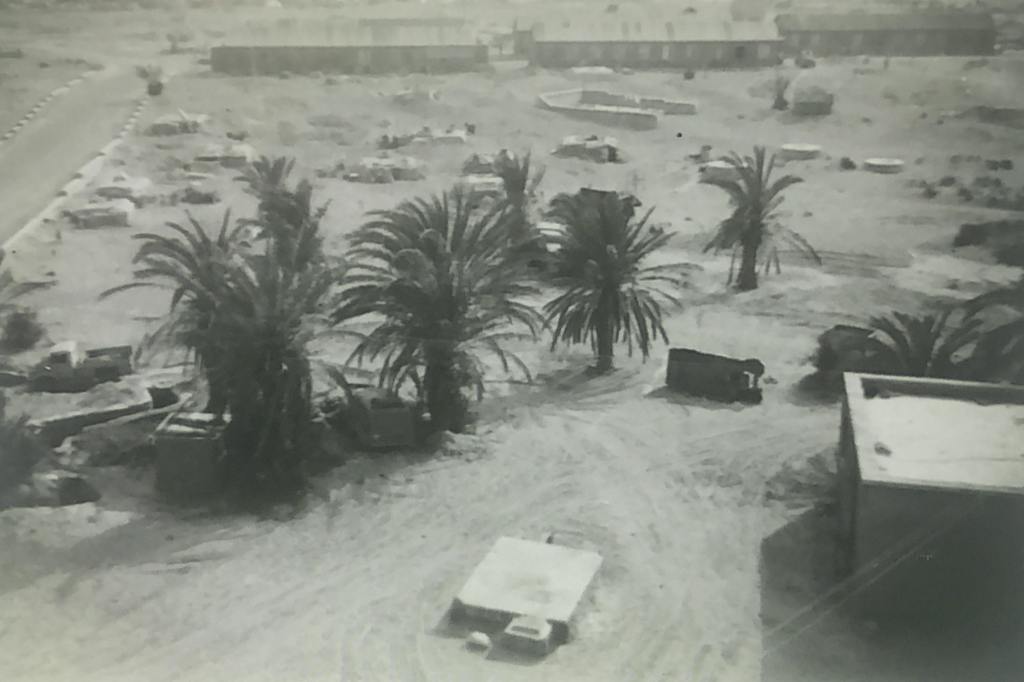
Taken from the Lido roof
The 22nd of January brought news that a battle had begun and that we were not doing so well. Some South Africans from a Light Armoured Corps, told us of a skirmish near Antelat, lots of dead and tanks ramming each other. One of them telling us how he killed his first German, very artistically apparently, with a hand grenade. We also saw a large number of recovery vehicles, bringing damaged tanks back from the front. We had several air-raids, and on one occasion Rodge, who was up on the roof with the Bren gun, shouted something down to us, immediately everyone dispersed like rabbits to cover, but it turned out that all he was doing was warning us that one of the footballs was being blown into the sea.
Early in February the news came through that a section of 261 Battery had been captured, including Dick Foley and the Major. There had been an unexpected German breakthrough by an armoured force, they were surrounded and couldn’t get their guns deployed in the anti-tank role, quickly enough. I thought, that there but for luck, I too should have been among them
” I thought, that there but for luck, I too should have been among them “
From the 11th to the 19th went up to Alexandria on leave. Met G.L. Wood, who is with the 1 Div Tanks. He told me that the sad news that Oscar had been killed, a great blow that.
On my return to Matruh they were all talking of the attack, the night before by torpedoes, fired from out at sea by submarine. Three torpedoes had been fired through the narrow harbour entrance, one of which had failed to explode and came right up on to the foreshore, and next day the naval people came and removed the charges and set fire to them on the beach about a quarter of a mile away, the heat from the burning explosive was almost unbearable even at that distance.
At the beginning of March, we had a boisterous spell of weather and even a few showers, and to our amazement within forty-eight hours there was a carpet of wild flowers in full bloom in the usually bare Wadi. Poppies, Dog-Daisies, and Milkmaids, also a fantastic sight of hundreds of wild geese flying high in the clear blue sky forming and re-forming into V and W formations. At intervals their throaty calls could be heard, on their way north to their breeding grounds in North Russia.
For the next month we just hung on in Matruh. Amusing ourselves on various projects, we made a diving raft, and tried to renovate a damaged boat. We even tried to make a boat out of corrugated iron, which on its first trial sank. This even amused the Colonel. Spent a lot of time fishing, sometimes with hook and line or in a highly exciting fish drive, at a place where at low tide the water rushed out through a narrow culvert from the vast salt lake. We caught grey Mullet, and it was excellent eating. There was also plenty of Octopus here, though we never tried them, but we did have several feeds of Shrimps.
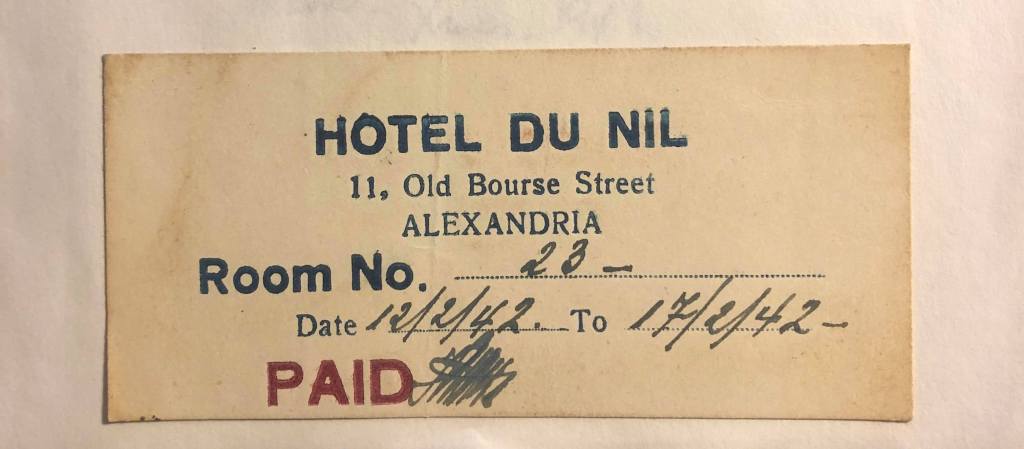
February 1942
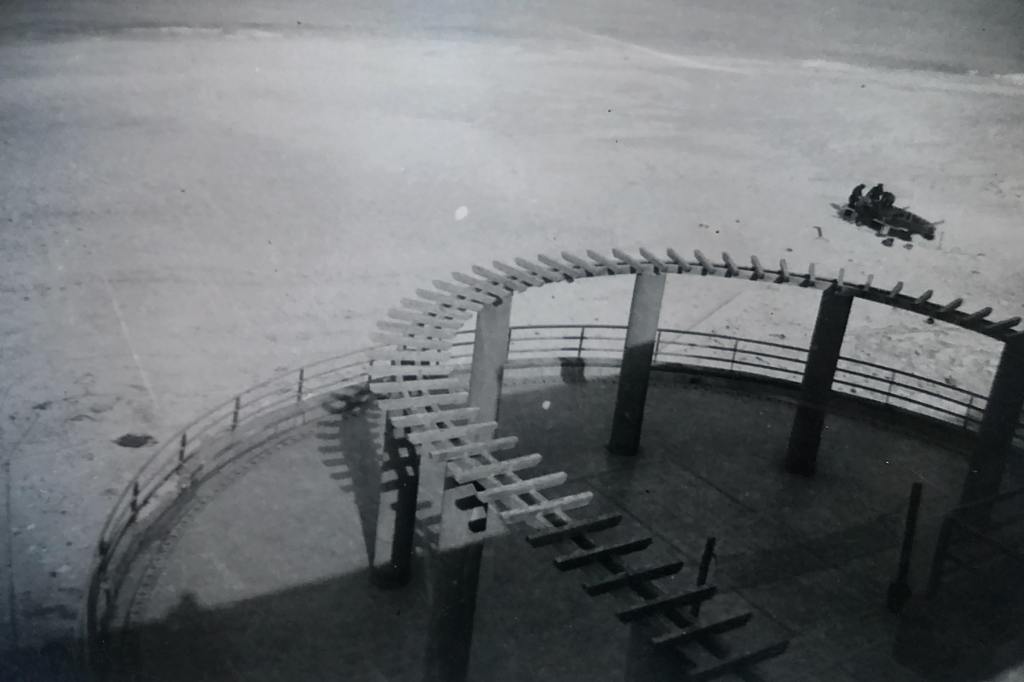
On the 19th of April I was asked if I would be the Doctor’s driver, and as there was no Survey work, agreed and took over the Dodge Pickup. Had a drive into Alexandria with one of the Officers, and went all over that town, Mex, Kom-el-dikka, and Hamra, came back the next day via El Daba. On the 17th we left Matruh and moved up the desert road to defend one of the forward Fighter Dromes. It was stifling weather for convoy work, the roads were packed with other troops, so we were glad to pull off the road for the night near Sollum, just before the road starts to climb the escarpment.
The next day we crawled up the Halfaya pass which loops up the cliff-like escarpment in several steep hair-pin bends, with a gradient of about 1 in 3. To make matters worse a sand storm blew all day. We turned off the road at Gambut and followed the desert track, putting up camp close under the shelter of a rocky sided Wadi, where the low escarpment outcrops. The rest of the country is flat as far as the eye can see and is covered with little mounds caused by sand accumulating in the small shrubs, which grow all over the surface, green now, but the sun will dry the vegetation up.
Plenty of evidence of German and Italian occupation, wrecked tanks and motor vehicles. Over on the northern horizon, we can see through a shimmering dusty haze, the tents and G.L.s of the Gambut Landing Ground and see the Hurricanes taking off and landing.
We were soon dug into our position, the sand was free of rock and so we were able to easily get down at least three feet, safe from air attack and straying tanks of our own. Everyone used to congregate round the Office lorry at 6pm to listen to the news.
“Everyone used to congregate round the Office lorry at 6pm to listen to the news”
One day an Arab camel caravan passed, headed by two men and three women, the women gaily dressed in bright colours and riding donkeys. A string of camels following in single file, some laden with bulky loads. One of these camels took fright and ran amok. It must have objected to carrying such a big load, it bucked and bumped until the load came off, then it disappeared into the distance with the camel drivers racing after it. They eventually caught the animal and reloaded it, amidst bad tempered grunts and groans.
My main task these days is to maintain the Dodge, this entails mainly replacing road springs as the terrain around here is very rough. I also run a Taxi service for the Sergeant who services the G.L.s (Radar) which are set up round the Landing ground.
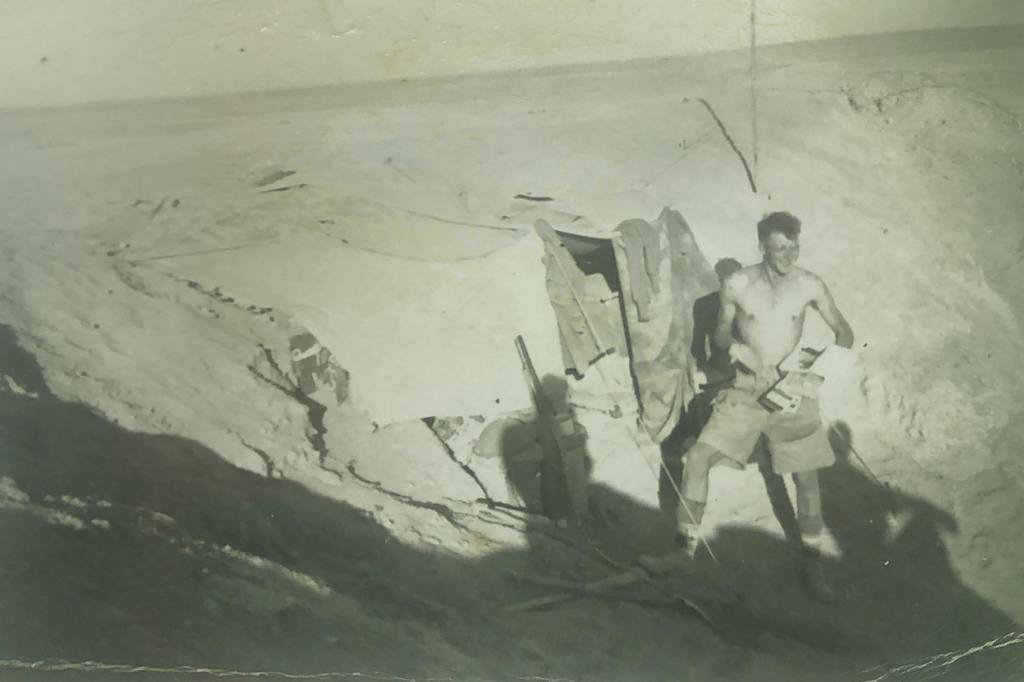
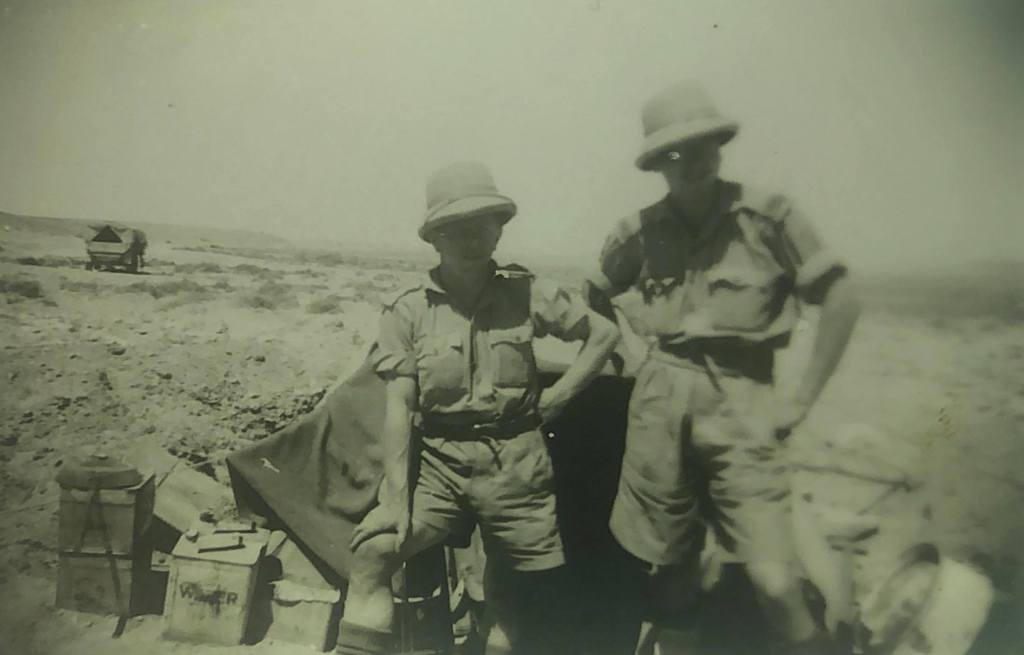
April 1942
On the 15th of May, whilst burning some rubbish there was a dull explosion in the fire, at first thought we were being sniped, and when I looked down there was a gaping wound on my left arm. I was rushed over to the Medical lorry, then had to go on to Field Hospital, just along the ridge. Here I had an X-Ray, and they found a piece of jagged brass about ¾ of an inch long.
In no time at all I was given an anaesthetic, and had the splinter removed. The other inmates of this tented Ward were all looking forward to me coming round, as the effect of the drug usually promotes exceedingly bad language, as the patient recovers. I stayed here for several days, until the wound was healing. The chap in the next bed, was a French Foreign Legionnaire, for Leclerq’s Army, though he was a Russian. He had a mild and amiable nature, unlike what you would expect in a Legionnaire.
The cause of my accident was a round of .303 ammunition, which I kept in my pocket and used to strip and clear the Lewis machine gun, but unfortunately I’d left a round in a pair of old dungarees that I threw on the fire, the bullet had exploded, and I was lucky that the piece of the casing only passed into the fleshy part of my arm.
” There was a explosion and when I looked down there was a gaping wound on my left arm “
On the 27th of May, I had to leave the Hospital in something of an emergency, and the Regiment had to hurriedly pack up, and move not west but east. Rommel’s forces had attacked and outflanked the line at Bir Hakeim and was advancing on Tobruch. We moved at night, even so we were staffed by German Fighter Planes in the moonlight. We eventually halted and dug in, and here we stayed until the 12th of June. All of the driving I’d had to do didn’t help my arm to heal, in fact it opened up again, so was glad of the few days rest.
It was whilst we were waiting at this camp near the Egyptian border that Rig said his farewells, broaching a bottle of Dewars to celebrate. We drank his health in the moonlight, and next day I took him to the Railhead at Metruh. Then had to get back to Capuzzo on the way having a refreshing swim at Sollum.
There was an amusing incident here wen one of our drivers had to go to this Capuzzo base for stores, Inkster (the canteen wallah) told him what to buy, and said that there were a few pounds over and to use his own initiative as to what to get. It proved a tremendous problem for him and he finally decided on a huge case of Andrews Health Salts. One man’s luxury is another man’s laxative!
” We were staffed by German Fighter Planes in the moonlight “
Water was short here, so we located one of the old desert cisterns, but the enemy had salted it. However, collected it for washing purposes. It was an interesting place, just on the edge of the rocky escarpment, the only clue to it was a stunted Fig tree. After searching around we found a small square opening cut in the rock, only big enough to get through and once inside it was about six feet deep and roughly ten feet square with a stony bottom which held a few inches of water. It was hard work lifting four gallon cans of water through the hole in the rock ceiling, but a tin of water thrown over us was most refreshing and revived our flagging energy.
On the 7th of June drove into Tobruch. It seemed most incongruous to be in a town and see people walking about on pavements and to see shipping in among the harbour buildings, after coming in from the featureless desert. The noise of the battle still goes on from the direction of the ridges at Knightsbridge and El Adem.
Just before the evening meal on the 14th of June the word came to move. This time we moved off further east, travelled until dusk and stopped to make a meal, then onwards, or more correctly, backwards.
We caught up with the main convoy at breakfast time after a night journey. After breakfast we crossed the wire at Sidi Omar, back into Egypt. We continued across the desert for another five hours, and never saw another vehicle in all that time. At midday the heat was stifling and the engines were overheating badly, the metal of the vehicles was too hot to touch. We drove all day on a compass bearing and churned along through many types of terrain. The worst, was an area of stony desert closely strewn with polished black rocks, each about as big as your head. This lasted for miles, and to our amazement the tyres stood up to it.
Driving became really exhausting, and when we halted for a rest there was no shade and with the vehicles giving off so much heat like hot radiators, even then it was cooler under them, than out in the sun. At the end of the day we were so shattered that we just put down a blanket and fell asleep. The next day we dug in and started surveying gun site positions on a landing ground to replace those we had had to abandon.
After five days we again got the order to move. Not surprised as the news from the front is not good and on the 21st Tobruch fell.
” We saw on the horizon ahead the reddish glow of bursting bombs “
On the 23rd of June we moved off further east, through Matruh, where we passed the New Zealand division, moving up to occupy the Mersa Matruh defence box. The roads were absolutely choked with vehicles going in both directions. Camped on the coast near Daba, and the next day surveyed three gun sites around the El Daba airfield. After a day surveying in the desert it was marvellous to get back to camp on the beach and have a bathe. The white sand and breakers delightful to look at in full sunshine or under moonlight.
The military situation didn’t seem to worry us very much.
However, on the 28th we moved east again. Jerry now close to Matruh, and we travelled all through the night. Just as the moon came up we saw on the horizon ahead the reddish glow of bursting bombs, this got nearer as we travelled, and we realised that we should have to run the gauntlet, as the bombing was at a place where the road crossed the railway, and there was no other way round.
Before we got there we were spotted and a plane came up on the right and turned ahead of our convoy and came hurtling back and raked down our left flank with machine gun fire. I could see the tracers hitting the road well ahead and hastily stopped the vehicle and dived underneath, but in my haste I had forgotten to put on the hand-brake, so had to just as hastily get back in the driving seat again, by which time the danger had passed and luckily didn’t get hit. The Doc in the passenger seat wondered what was happening as he had been fast asleep and had not come to enough to get moving.
We were about to cross the railway when the bombs came. We got as far as the crossing when a stick of bombs exploded close behind us, we breathed in relief when we saw the last of the line burst, just then another plane swooped in and straddled the convoy. One of these burst on either side of the fifth vehicle ahead of us. Fortunately, the track was through very soft sand and though it meant that we could only grind along in first gear, the splinters didn’t fly, but it was too near to be pleasant, and had to trust to luck as some of the vehicles had been hit and were on fire, providing the enemy planes with a clear view. In fact we got a superb view of the bomber as it banked low above us, we could see the underside illuminated by the fires below, and lights showing through the open bomb bays.
After this we kept our heads down and eventually arrived at our destination early on the 29th of June 1942, at a camp on the Cairo to Alex Road.
The amount of motor transport assembled in this area was incredible, but within a day things had been sorted out, and we started surveying a landing ground at Karm Quattara to fix the gun sites, and were soon organised enough for us to have trips into Alexandria for haircuts, drinks, eats, and cinema shows. A squadron of Spitfire fighters were exceptionally busy from the airfield just across the road, and we were fascinated to watch them taking off, and landing until it was practically dark. How they could see the ground at such times I do not know.
” We were about to cross the railway when the bombs came “
One night I had to take the Doc to a Battery in the desert. We didn’t leave until 1am, in the pitch darkness I drove over a slit trench, the Doc had his head out of the side window at the time trying to see where we were going, and as the wheels went over the trench his head went up and down like yo-yo, between the roof and lower sill with some force. Luckily he was partially insensible with drink. Further on I almost drove through a Bedouin tent but saw it in time and backed off, though not before we had disturbed the inmates, together with several chickens and dogs. Eventually arriving back at our camp safe and sound.
I was usually detailed to take the leave Truck into Alex and one return journey late at night swerved, at a point where the tramlines diverge and continue on their own separate track. In the gloom I didn’t see this until too late and had to swerve rather violently to keep to the road. One bloke fell off, he was the only sober one aboard, he grazed his hands and knees badly. He afterwards complained of a back back, and even tried to get invalided out of the Army because of it, though without success, or sympathy. On the 23rd of July went to 261 Battery for four days who were up at Borg el Arab, and did some surveying.
At the beginning of August we helped on a big scheme to make a “going map” across the desert, from Wadi Natrun on the Cairo to Alex road, due west to the Quattara Depression. I think this was part of a big bluff to make Rommel think that when the Offensive came to break through the Alemein Line, it would be from this direction. However, we had to sit in the back of a three tonner, which was one of a line of twelve such Lorries arranged about four hundred yards apart. At the given signal the whole line moved forward and notes were made of the surface of the desert every quarter of a mile as called off the speedometer. During this exercise we came across an interesting Coptic Monastery, isolated in the desert in Wadi Natrun. We talked to some of the Monks who were very interested in Diesel engines, and were very knowledgeable. At one place here the G.T.V.s got stuck. These heavy vehicles went through the dry salt crust of the Wadi, into the mud. I was sent on foot, across the desert to get help.
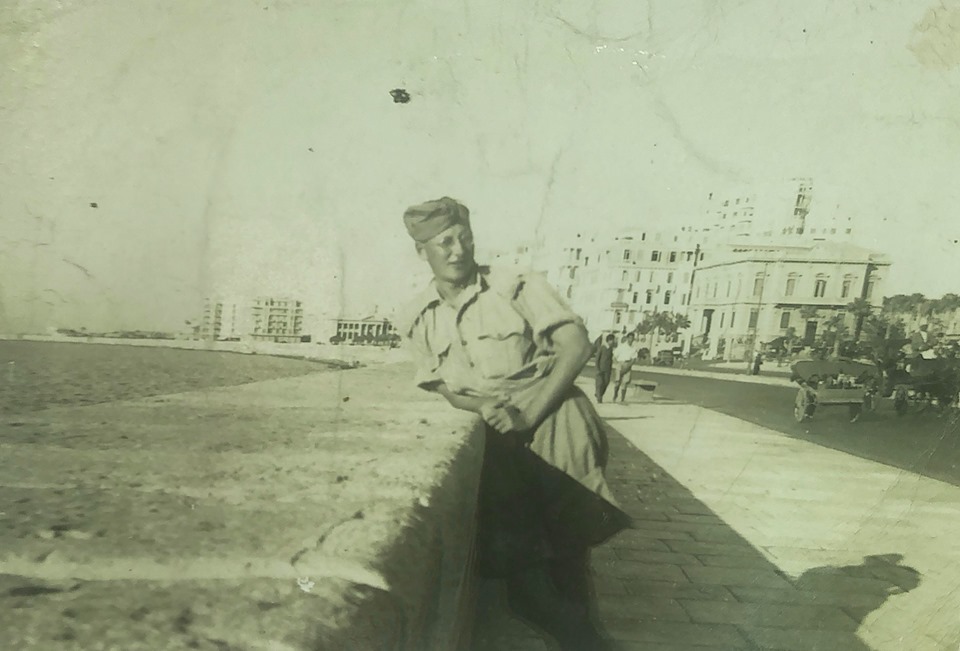
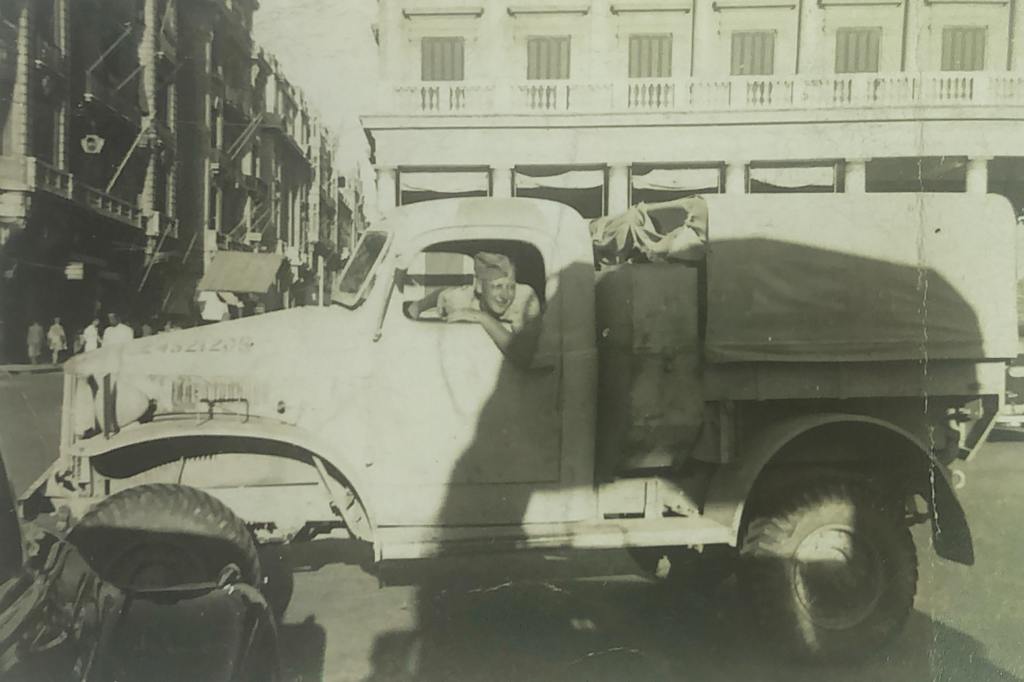
Another project was to erect a target for the 3.7 A.A. guns, consisting of large oil drums, 8 drums high, to practice firing A.A. guns at Tanks. The Germans had already begun doing this very successfully with their 88mm for some time.
Towards the middle of October, we did a lot of surveying forward, so that the guns could go into marked positions as soon as the attack goes in, to defend the forward landing grounds.
On Friday the 23rd of October we were briefed on the forth-coming battle, and at 4pm that day, Rodge and myself went off to the forward sites. At 10pm the Artillery barrage started up and the flashing and noise went on all night, this together with sweeps of Aircraft created a terrific din. Both we and the enemy certainly knew that the big battle had begun. The gunfire and Air activity continued next day. Stan came back from the water point saying that he had seen lorry loads of Jerry [German] and Iti [Italian] prisoners. Whilst we waited to join the advance we discovered a fig orchard in the desert somewhere near Borg El Arab, and picked a whole bucketful, which Stan made into jam.
On the 4th of November we joined the stream of traffic to the west, past Alemein Station and on to Tel el Eisa, where we parked for the night through Diamond Gap in the mine-fields and just in front of an Australian 25 pounder Regiment, who were still firing at the Germans in the ‘pocket’ on the ridge.
Early next day November the 5th, the fireworks started before dawn and as it got light two Messerschmits dived in and dropped their load. After this we pulled out and advanced to El Daba. Here the roads were littered with dead Germans, wrecked tanks and lorries, also one or two abandoned 88mm Gun emplacements. At these places we had to swerve from side to side to avoid running over the dead. We later came up to a convoy of Australian infantry, who were going back, one dressed up in Italian General’s uniform, and displaying hands with gold rings, presumably looted from the dead.
On the 7th of November still going forward and still the roadsides littered with blanket covered bodies and wrecked vehicles, the contents of the trucks strewn all over the road, rifles and picked over. We stopped at West Daba for the night in what had been an Italian camp, plenty of loot about, rifles, soap, ground-sheets and food. Everywhere there were papers, letters, and photos in an untidy mess. The next day’s advance produced the same scenes with the added destruction at Railway stations of blown up trains and engines. Halted for the night at Garawlah. News from the other front is good, a Yankee landing in Algiers.
Continued our advance through Matruh, here we passed hundreds of Italian prisoners walking back along the road, trying to get lifts, but no one taking any notice of them. Some were driving themselves in their own lorries back to the frontier and captivity.
We stopped for the night at the old camp, near 75 Landing Ground, where even the survey poles we had left standing on our retreat, were still in place. But nearby a rather grimmer relic by the side of a burnt out German Armoured car was two shallow graves, which some desert rodents had disturbed, uncovering the feet and gnawing at the toes.
After a brief halt here, on the 13th of November we crossed the Egyptian frontier into Cyrenaica, and meandered our way through the mine-fields, then on to the Trigh Cappuzzo track to the old site at Gambut. Here we had our first wash for a week as water was severely rationed, but we knew from our previous occupation in this area, the whereabouts of tank water for this purpose. We were surprised to see a raven fly away from the stunted fig tree which grew above this cistern.
On the 15th of November we moved to Gazala via Tobruch. Tobruch, in spite of its battering, has a unique atmosphere. The change is so dramatic as approach over the slope, out of the barren desert and see in front of you the dazzling white buildings, with the high white cliffs rising out of a now placid blue expanse of harbour. There were lots of wrecks, with only the masts and funnels showing, several of our own damaged tanks, and the barrier at the perimeter was riddled and pock marked with bullets. The next day to our astonishment and discomfort it rained all day.
Suggests that the British were finished, and recommending that the Egyptians support the Germans.
Another day of waiting, so strolled over to the sea shore across the salt marshes, teeming with mosquitoes. Up at day-break the next day and after a wet and miserable breakfast, moved off along the coast road. The weather cleared and we had a good day’s travel through a very different country to what we had become accustomed to. It had red soil, with rocky outcrops, shrubs and greenery abound, and more striking still there are running streams. These are no doubt temporary but grant to see. Dare not stray from the road as the verges are mined. A German bomber came over today and hit a heavy lorry immediately in from of our convoy. Arrived at Martuba, where we stayed for eight days, and on the 25th continued westwards on the coast road, the surface getting better the further we went.
The scenery reminded me of the English downlands, except that the main shrub was Juniper and Cyclamen were in flower everywhere. A few Italian Colonial farms were dotted about and it was strange to see grazing cattle, though the fields looked more like stone yards, and I would think these to be very marginal farms. At a place called Mauraua we turned off the road, and gradually the track reverted to the desert scene again, a rockier and more hilly terrain, which soon changed to a region of wide deep wadis [valley or dry riverbed], with hills dominated by the ruins of old stone forts.
” The scenery reminded me of the English downlands “
The track was rather alarming, as owing to the extreme lateral camber, the vehicles seemed in danger of falling over sideways, especially when the forward gradient was also in the nature of a 1 in 3 slope. After this the wadis broadened out and levelled off into long stretches of hard salt flat. These were fast going when dry, Had a gourmet meal tonight of bully stew with M and V. Did a few surveys, including one of plotting a minefield on to the map.
Met some Yank [American] air crew. One of them tried on a steel helmet He pulled the chin strap down, then went though the motions of chewing, and said, ‘I can even eat in it’. Our grub is still good. I think it is because we are getting American style rations They are packed in a box and contain everything to last ten men for one day or one man for ten days. Even toilet paper; if we remembered what that was for. Tonight we had rice, the first time for months, and a welcome change.We were now about 30 miles from Msus, and the next day the going was even faster than the day before, firmer and smoother, and the whole convoy bashed along at over 50mph. As we approached Msus the desert became stonier, with long stretches of shingle in the bottom of the shallow wadis.
We arrived before the rest of the convoy which limped in several hours later, as they had gone off the track and the Office truck had hit a mine. Fortunately, not much damage: the driver and passenger were well protected by the sand-bags on the floor.
The news on the radio tells of the scuttling of the French Fleet in Toulon. On the 29th of November we were out on survey of yet another Landing Group, and saw a couple of spitfires crash land. Also today the canteen came up with soap and chocolate and I also shared half a bottle of whisky, to celebrate getting some soap had a wash all over.
From the 4th to the 7th of December we had an easy time, and we received a big batch of mail, which had caught up with us at last, this was good as we had plenty of time to write back. Also got the opportunity to mend the punctures in two of the truck wheels, which up to now I had not had the time to attend to, and as the tyres were run-flats – having a four inch solid rubber ring inside each one, so that they could be run even when deflated. No sooner started on this job when I was given the order to move off. Left at 3pm and travelled the first 20 miles towards Antelat. From here we spent a few days on a ‘recce’ of desert tracks, in anticipation of our next move. One day we had an arduous journey far to the south in the desert, on the Jalo Oasis track. When we were returning along the track, saw Montgomery on the prowl.
On the 8th I had a ride to the water point at Zeutina with Stan in the water truck, it meant a round trip of 112 miles, on the way back met R.H.Q. in convoy, so had to turn about and tag on behind, wondering what had happened to our tent and kit. Finished up at a place of sparse vegetation and bare stony undulating hills and valleys, and shown on the map as Nogra.
” When we were returning along the track, saw Montgomery on the prowl “
When the sun goes down, the steep straight edges of the hills throw unnatural square shadows, and appear like those from tall buildings in the city.
On the 17th of December made a recce of a route which had been proposed, so that our guns could proceed forward and get mixed up with the heavy traffic all pressing forwards along the coast road. It proved to be exceedingly rough going, I drove along it for about three hours, continually in second gear over bone shaking, tufted scrub and undulating sand desert. Eventually we turned back and got to camp in the dark. I only saw one other vehicle all day, and this was far in the distance. The scenery was out of this world, and the sunset superb. Such a wild isolated stretch, as yet untouched by the armies.
The next day we moved off, but not on the track we had been on yesterday, which was unanimously considered unsuitable for our 3.7 Guns, so back on to the coast road with all the rest. We passed through Marble Arch, an imposing dazzling white block, bestriding the road, with an exceedingly high narrow arch, through which all the traffic has to pass. The only decoration on this colossal monument is the sculptured figure of a man lying in a rather unnatural position high above the arch. It was built to glorify the Fascist Regime, and as it is the only feature in this barren landscape for at least 50 miles radii, and certainly has nothing to compete with as it is the sole man-made structure to be seen from one horizon to the other. I stayed behind here, to act as a report centre for the Battery as it came up.
The guns arrived next day and I had to lead the way to the sites, and then returned to R.H.Q. at a place called Merduma, nothing but stony desert and an old Arab well, but as Merduma means ‘the well of the laxative’, did not sample the waters.
Here we spent Christmas 1942. Surprisingly we had fresh pork for dinner, and very good it was too. Stan and I made preparations for a party to celebrate. We first of all made an oven and I spent most of the day stocking it with dried desert scrub. Stan made Banbury cakes, a fruit flan, and sausages in batter. He then cooked a Christmas pudding, made from crushed biscuits with currants and raisins. We cleared out Bill Kellet’s 3 Tonner, and set up a table for about nine of us, and had a hilarious meal. Rodge got the threepenny bit out of the pudding. Before the meal the table looked quite a sight. There was no gleaming silverware or expensive crockery, only mugs and tin dixies. But colour was supplied by the mince pies, the fruit flan, cheese and biscuits and the bottles of ale, laid out on paper doilies cut out of the current issue of Picture Post. There was even a handwritten menu. It was a great success, and those not on guard went satisfied to bed. Though naturally everyone had nostalgic thoughts of those at home.
” Here we spent Christmas 1942, Stan and I made preparations for a party to celebrate “
Next day had a trip with Stan for water, 150 miles there and back. As we went through Marble Arch we noticed that someone had painted Christmas Greetings on the arch in huge letters.
On the 30th of December, Rodge and I had to go to Nofiliya, to survey a new Landing Ground. We were taken in one of the Battery 15 cwts and were rattled over rough desert from 7.30am to 3pm in the afternoon and were nearly gassed by a broken exhaust. Finished the survey the next day and had to wait around until the guns came up. We celebrated the New Year with a lot of rum. When we got back to R.H.Q. at Alem-el-Chel, we immediately had to go off on another survey to a landing ground at Wadi Tamet, sandstorms made things difficult. 291 battery arrived and we were told to go back to R.H.Q. On the 10th of January 1943 we learnt that one of our 291 lads had been killed in an air-raid on the Wadi Tamet landing Ground. They had managed to shoot down three of the enemy aircraft, though they claimed seven.
” We celebrated the New Year with a lot of rum “
At this period there was a lot of stuff moving up, including armour, so it looks as though there is going to be an attempt to force the Beirut line.
On the 14th of January we were ready to move on a ‘left hook’ through the desert, to outflank the defensive position ahead. We were attached to the 2nd New Zealand Division, and we knew we were bound for Tripoli. The next day there was a lot of gunfire in the distance, over the hills near to the coast. We also had a ‘Stuka’ raid, we certainly kept our heads down, it’s a very frightening noise as they dived to the attack.
For two days we travelled across some rough country, wadis with the occasional stunted trees and at times very steep stony hill track, in other places we followed dry river beds, and every now and again had to brace ourselves as we dropped off one strata of rock to another, some of these steps being about two feet drop. After the third day we started to travel only at night, resting up during the daylight hours. Our water ration was down to half a pint a day. The countryside became much more undulating and greener, and we joined a road leading us into the town of Beni Ulid, which we passed though in brilliant moonlight.
Sadly on the night of the 21st, two members of 261 Battery were killed by mines.
On the next night we made a mad headlong dash, bump, wallop, crash, bang over increasingly hilly and stony ground. We bypassed Tahuna and were then about 25 miles from Tripoli.
On the 24th of January we started a way through a stretch of very soft sand, and we saw quite a few Arabs about. After about eight miles we got back on to a road, and soon started to get into a cultivated area, the fields getting greener, and trees becoming more numerous, with Italian style farms appearing, the further west we went. The first place we came to was Azzizia, here we halted in the shade of a Eucalyptus grove for a meal an then as the moon came up we moved out of Tripoli, and bedded down in the road for the night, outside the hospital at the Benito Gate.
On the 25th of January Stan and I had a stroll around the town, and went into the Italian Government offices, which are now empty and deserted, but the furniture still intact. I found a pair of proportional compasses and some boxes of coloured pencils. Stan looked in a cupboard and found a scarlet Judges robe, superb material. He took this with the intention of sending it back home. After this looting, we watched the Arab and Italian residents going about their daily business.
” We also had a raid, we certainly kept our heads down, it’s a very frightening noise as they dived to the attack “
Further in the town and especially around the harbour was pretty extensive. Our R.H.Q. was set up in the former Governor’s house, and we lived in a villa high up on the cliff’s edge, and slept under a roof for the first time for many months. We woke each morning to the sound of the surf on the beach below. In the town the shops were opening up, rather nervously at first, not quite knowing what the soldiers would do. We bartered for eggs, oranges and vegetables with cigarettes and bully beef, but on our first pay day we were paid in British Military money and this was accepted as the currency.
At the end of January we moved from the luxury of the Governer’s house, to more modest quarters in Via Francesina D’Assisi, here we had running water and electric light, and a balcony where we used to watch the street life go by, and talk to the kids. There were a few air raids, when the Harbour barrage used to open up and rattle the shutters. On the 4th of February Churchill came to review the troops of the Highland Division. All the tanks and vehicles were drawn up along the Esplanade, and he with Alexander slowly passed in a staff car, little did they know that a good proportion of these ‘bullshitted’ vehicles had had to be towed into position.
” As soon as the airfields became operational the Germans raided these several times a day and started to shell the road “
There is a wonderful Souk here in the Arab quarter, and its tortuous narrow streets are lined with leather goods, carpets, copperware, and silverware, all made on the spot. Stan who had been a keen Rover Scout, discovered a Scout Troop here in Tripoli, the 1st Tripoli Rover Scouts. We went to their headquarters and made several friends.
On the 22nd of February 1943 we moved off to the west, along a dreary road through the salt marshes to Zura, and were back in the sand. Rodge and I had to continue to Medenine, a hundred miles ahead, we stopped for the night just over the Tunisian border. The next morning, we went on to Medenine, here we split up, and Rodge surveyed the Airfield here, whilst I went on to Nafatia. The only detail on the map to which I could fix this, was a milestone on the Foum Tatahoune Road, and had to measure the distance from this by the speedometer on the Jeep, as I had no assistance and time was pressing.
As soon as the airfields became operational the Germans raided these several times a day, and on the 21st of March started to shell the road, above our camp, so we eventually de-camped.
At the time it was decided we should move move, I could not go because the Jeep had a broken axle, and needed a suspended tow. I was left behind until a recovery vehicle could come and take it into the Workshops. However, this lorry got stuck in the soft sand and had to be winched out, and so after a great deal of sweating and purple language we got away to the workshops in Medenine, all this whilst Jerry was shelling the road above. I slept the night under a stone horset rough for protection. The road packed with troops and equipment moving up all night. There were a few explosions and now and again flares appeared over the Mareth Line.
On March 4th we moved back to Medenine village, here there were a cluster of native beehive shaped huts, which interested us, and we decided to investigate these curious structures and found to our discomfort that when we came out we were infested with fleas. There were also plenty of Scorpions about.
On the 6th the road above our camp was again shelled, and the noise of a battle lasted all that day, with dog-fights going on above and the screech of the shells from the long range German guns adding to the din. Apparently a determined enemy attack was in progress. There was an intermittent shelling all night, but next morning it seemed that the danger of a breakthrough is over, as the German armour has retreated back into the hills.
In celebration the fighter planes on the Drome, fired off their machine guns and cannon, as they stood on the ground, and the sky became full of green and red flares. It was quite dangerous to be anywhere nearby.
On the 16th I celebrated my three years in the Army, with a bottle of beer. It is rumoured that we may be sent on leave to Tunis. The next day we were on survey again and nearly got shot by some stupid Yanks who were taking pot shots at our survey flags. On the 21st we moved back to El-Djem. The roman Amphitheatre here is very impressive, but we could not explore it, as it was reported to be mined. Along this part of the coast there are a lot of Roman remains, all that remains of a thriving and long gone fertile country. It is interesting to think that we are the last of the armies that have passed this way. On the 23rd of May, we arrived at the Sorman Landing Ground, and surveyed in the guns. We heard some strange creaking noises, which occurred just at sunset and again early in the morning, our curiosity was aroused so one evening we strolled over it its direction, and watched an interesting operation of drawing water, the noise coming from the rope round the worn wooden pullies. A bullock was pulling a rope down an incline, thus in turn pulling up a laded water skin, so that when it got above the height of the rope, the skin opened and let the water out.
” On the 12th of May, the news came through that there was no longer any organised enemy resistance in Africa “
On the 26th of May I had to go to Tripoli with the Canteen wagon and when we got back to camp found that the Regiment had been recalled to Sousse [in Tunisia], so had to follow. We halted, once more in the same wadi at Medenine, and took the opportunity to climb up the prominent Castle Hill, above the village. We had never been able to get here before, but now there was no enemy in the Mareth position. The view was terrific, looking west, the foothills gently getting higher to the purple horizon, below us in the middle distance, the white building of Medenine looked like a heap of crystal sugars, and in the North, you could glimpse the sea.
The next day we caught up with the others, at Sousse, where we camped in an Olive Grove. We had a funny incident during in an air raid one evening, when one of our drivers, who had acquired a pet rabbit, let it out and it took refuge in a hollow Olive tree, to get it out he stuffed some smoking newspaper into the recess, but unfortunately though the rabbit came out, the tree caught fire and the only way to get the fire out was to hitch it up to the truck, and drag it apart.
On the 1st of June 1943 I was told to report to Brigade. The job was to drive an Ambulance (I was one of about 30 drivers), and we went in convoy down to Tripoli, where we left them, parked on the Grand Prix Motor Racing Circuit. In the meantime the Regiment moved back to the Aerodrome at Castel Benito, and I re-joined them there.

On the 19th of June, Rodge and I were told that if we chose to remain as Surveyors, we shall be posted to some other Regiment. Apparently no Surveyors in future are to be included on A.A. Regiments strength. It wasn’t an easy decision, but in the end I suppose it was our pride in being Surveyors that decided us to elect to remain such. So we expect to move at anytime.
So on the 28th of June, 1943, after being over two years, up down the Blue with the 94th Hay A.A. Regiment, we were posted as superfluous to strength, and found ourselves in the Transit Camp at Tripoli. I remember this Camp as a bare dusty tented site, sloping gently to the beach, it seemed a desperate spot, though its one saving grace was that it tended to be cooler than the 120 degree in the shade, at Castel Benito, inland.
Leaving the Regiment was a depressing experience, as I had been with this Mob for two and a half years, and having just completed the advance from El-Alemin with them, made it a sad anti-climax. The Transit Camp was an incredibly shabby and inhuman place, unlike the familiar and friendly atmosphere in the Regiment, here nobody has the slightest interest in anyone else, and you quickly find that it pays to keep a very low profile, otherwise you find yourself doing the most objectionable fatigues, day in day out.
At the beginning of July, Roger, another Surveyor from the 94th, also posted, and I were sent on a course for O.P.A.c’s and G.P?O. A.C’s, which was welcome. This gave us something to occupy our time and it also enabled us to move around less furtively, to avoid being caught for fatigues. Not that we relished the idea of becoming O.P.A.c’s. It was like going back to school, partly as the classes were held in an Italian Infants School, and also because we sat at ridiculously small desks. It struck us as rather funny, especially as the subject we were studying was the art of lobbing Artillery shells as near as possible to other members of the human race, not the usual curriculum for an Infants School.
” It was like going back to school [except] the subject we were studying was the art of lobbing Artillery shells as near as possible to other members of the human race “
News of the Sicilly landings was now trickling through, and casualties were coming back, so it shouldn’t be long before we get a posting. Towards the end of this specialists Course, Rodge applied for and was accepted for O.C.T.U., and he left Camp on the last day of July. I missed his company and was glad that Eric was still down at the Hospital, where we met several times for a chat.
At this time I started to feel hellish groggy, and it was really a struggle to keep any enthusiasm for the Course studies. So after the Trade Test on August 6th, I reported sick. The uninitiated may wonder why I had not done so before, but believe me, to go sick at a Transit Camp is quite an ordeal. Because it is assumed by the permanent Staff in charge, that all going sick are swinging the lead and are malingers, and do it merely to escape doing duties. So the path is made extremely arduous. Firstly you have to parade at a precise hour, usually very early in the morning and then march down to the Sick Tent. You are then seen by a Medical Orderly, who no doubt has orders to relieve the Doctor of all, or most of the patients. I made the grave mistake of saying that one of my symptoms was slight constipation. Hearing this the orderly literally leapt upon it and forgetting everything else, gave me an enema, there and then on the concrete floor of the hut. After this I was glad to get back to the tent and lay down.
Two days later I was feeling really ghastly, and so picked up courage to go sick again. This time the Doctor saw me and I was immediately sent off to the 2nd General with Malaria. Though this was not a bad malarial area, it was rife in Sicilly, as now a lot of soldiers were returning through this Camp, this it how I must have caught the infection. I’d never felt so ill in my life, and by the time the Ambulance arrived at the Hospital, I was just about passing out. I can only recall staggering across the ward, and thankfully collapsing on the bed where I remained for eight days.
On the 15th of August I got up for the first time, feeling decidedly shaky. After this I was whisked away to the Convalescent Camp, where all there was to do was to take a draught of medicine at 10am each day. By the 26th of August, I returned to the Transit Camp and had a trip to Tripoli, to see Eric, and unexpectedly found him as a patient in the Hospital he worked in, my visit coinciding with his return to the Ward, just coming round after anaesthetic, nothing serious, just the removal of a troublesome wisdom tooth.
On the 3rd of September 1943, which was the fourth anniversary of the War. I was posted to the 69th Medium Regiment. This was great news, and I was glad to leave the Transit Camp, and to know that I belonged to a Regiment again, though feeling some apprehension as to how I should be received especially in the Survey Party, and as to what the Lads would be like. I had no need to worry however, as no sooner than I was deposited at R.H.Q. than I was introduced to Harry Gardner. He seemed to be in charge of the Cookhouse at the time, and he certainly looked the part. He was wearing just a pair of shorts, whilst in his hand he held a ladle, and the inevitable fag behind his ear. He soon had a special brew going. This R.H.Q. Camp was just like you see depicted on the screen, or in the Theatre, when a Camp out east is staged. It was set in a green bamboo and cane thicket, for purposes of camouflage, and to me seemed really homely after the barren worn and dusty plain of the Transit Camp.
” I was immediately sent off to the General with Malaria “
Harry and I, from this day on, became partners in the Survey Section, and I was soon on friendly terms with the rest of the Party. The 69th Medium were a Welsh Territorial Regiment, originally, the Caernarvon and Denbigshire Yeomandry and most of the R.H.Q. Staff and Battery Officers knew each other in civilian life. The set up in fact almost the same as with the 94th, except that here Welsh was spoken and not the Gaelic. They were comparatively new to the country, and had only been out of England a few months.
For the next week or so it was a waiting game. We knew that something was in the air involving a landing in Italy. We passed the time swimming, visits to the N.A.A.F.I. and sessions with my old Pals of the 94th (who were still around), and once or twice I saw Eric. During the mornings there were fatigues to be done, rather more pleasant than the ones at Transit Camp. On one of these fatigues, we took a lorry on a scrounge for firewood for the Cookhouse. Scouring the district, we found a most comprehensive Iti ammunition dump and got a load of dry, easily chopped firewood, by taking the shells out of the boxes, leaving the whole place littered with live ammo.
The 13th of September 1953 saw the Regiment on route for the Tripoli Docks, and by 10.30 that morning we were installed aboard T.L.C. 320. We sailed at 6pm, leaving Africa behind.
During the next two we sailed generally northwards, on a calm, beautifully blue sea. As far as we could see there were no escorts. We didn’t know precisely where we were bound, but the natives back in the Bazaar, said it was Salerno [Italy]. On the second day out we sighted Mount Etna, and later the toe of Italy. Eventually we passed through the Straits of Messina, here a constant stream of L.S.T.s were ferrying the 8th Army from Messina to the mainland at Reggio. In scale and urgency these craft seemed like busy ants, darting to and fro across the strait. We were all interested in seeing land, especially the Italian coast. I was particularly delighted to see the greenness, refreshing after being used to the desert scene so long. The coast hereabouts looked very inviting in the sunshine, white houses dotted here and there amongst the greenery of the coastal plane, with the mountains rearing up behind.
Towards evening of the 15th of September we passed the island volcano of Stromboli, which gave off an occasional puff of smoke. As we neared Salerno we could hear the gunfire, and there was a certain amount of aerial activity. In the bay, one of the naval ships; which we subsequently found out to be the battleship Warspite, was shelling with its 15 inch guns, the area just to the north of Salerno, where a large German gun, mounted on the railway was shelling the beach area from the shelter of a tunnel entrance.
” I was delighted to see the greenness after being used to the desert scene so long “
On the morning of the 16th, our turn came to land. The vessel was run up the beach, the forward doors dropped down and to the shouts of the R.S.M. we doubled over the sandy beach, through some grassy dunes and into the shelter of the trees and lanes, where we set up our camp. We knew that our hold on the beach-head was indeed tenuous, but we hoped for the best. Our R.H.Q. were camped in a small fertile valley, a short distance inland, and what was really wonderful was to see fruit trees and grape vines all full of fruit, and fields full of plum shaped tomatoes, so many that they are fed to the cattle. The ultimate after the desert scene was to see milk white cows, eating piles of tomatoes, in a green field.
Not all was roses, as the smell of putrid dead cattle, killed by shrapnel, was around to testify. Although the place delighted our eyes, the Military position gave us some concern. All we knew was that we had got ashore unscathed, but the noise of the aircraft overhead, and tremendous continuous shelling in the near distance, meant that we were not out of the fire yet.
On the day after we landed, the Survey party were out. Harry and I went to a Tobacco Factory, which had a splendid view of the whole area from its roof. There was a big German counter attack going on to the south, this was halted mainly by naval gunfire, from Destroyers out in the bay. After this the situation improved and generally the bridgehead was steadily pushed out.
It was at this time that I was persuaded to become a driver. Up to now I had denied that I could drive. This came about because Chuck Swallow, one of the Survey Party was feeling ill and the Truck he drove, and ancient 15 cwt Chevrolet, which had something wrong with its petrol system, and would race away or stop, depending on its capricious mood. So under these circumstances I agreed to take over this knackered Chev.
On the 19th I was informed that I had got a posting to the R.E.’s 512 Field Survey Co., but did not want to go, and so it was decided to ignore it as if we hadn’t received the order. At the end of September the fine weather broke and a terrific amount of rain fell, soon the roads were seas of mud and it became difficult to keep the trucks moving. The ‘Chev’ was no exception, even worse, as it still had smooth sand tyres. On one occasion, with the R.S.M. as passenger, going along a narrow farm track, to avoid a G.M.T., I got too near the edge of a huge dyke and just slid sideways to the bottom of this water filled ditch. The R.S.M. on the left was seated in about 3 feet of water, I was luckier being on the high side and managed to scramble out dry.
The truck by this time had become practically unmanageable so had to take it to the L.A.D. where they fitted a new fuel pump. I stayed here the night, in front of a roaring log fire in an Italian farmhouse, and returned to R.H.Q. the next day.
On the 28th of September 1943 the order to move came at last, and after a night stop in a Jam Factory This factory though partially destroyed by fire had in its store a considerable amount of sugar and jam, packed in wooden punnets, still intact. We managed to collect about half a hundred weight. Another luxury here was the heat from the still smouldering fires within the walls of the buildings, we hung our wet clothing on long wooden poles, and precariously fixed them over the heat to dry.
We finished up in Pompeii. This town seemed a squalid place, accentuated perhaps by the hungry drawn faces of the locals, who it appeared had not had a very good time under the German occupation, but they seemed genuinely glad to see us, and were grateful for any spare rations. On a survey recce, we climbed onto the high roof of a Nunnery, this overlooked Old Pompeii, which was laid out below us, whilst in the distance across the olive green valley dotted with farmsteads, appeared the massive shoulder of Versuvius, with a slowly rising plume of smoke coming from its crater.
Between the 1st and 4th of October we completed several Survey Schemes on the slopes of the volcano, amongst the vineyards and orchards, and met the country-folk, most of whom seemed to have relatives in America, or who had lived in the States, and spoke English with broad American accents.
” In the desert we could have dug a salt trench and slept without a worry “
On the 3rd of October I was called out late one night to take an officer to H.Q., this involved a drive in the dark along abominable tracks, and had a collision with an Armoured car, which had parked in the middle of the track. I stayed the night at T.A.C. H.Q. and slept in the cab of the truck, pulled off the track as far as possible, as there were tanks expected to be on the move during the night, and though I didn’t fancy being ironed flat, thought the risk worth it, to avoid sleeping out in the mud and rain. In the desert we could have dug a salt trench and slept without a worry.
From Pompeii we went to Albanova, passing through Aversa, which was a fairly large town and seemed not to have been affected by the war. Shops were open and had things to sell, from radios to fancy cakes. We took up quarters in a granary, part of a Cooperative Agricultural Centre. We slept in a storage barn, containing two huge wooden vats full of rough red Vino, and stacked with sacks of walnuts. German stragglers were reported to be about, so the guard on the nuts and wine was doubled, and after patrols were sent out, some German Tommy guns were found, but to our relief no enemy soldiers were encountered. As usual the Survey Party were kept busy for the first few days after each move, once we had got the gunsites fixed we could relax.
It was here at Albanova that we were called out late one night to check the line from one Battery to the others using lights to observe on. Apparently there was some discrepancy in the shooting, and the survey was suspected to be in error. These lights had to be placed in open and outstanding situations. The only, and favourite places here, were the numerous Church Towers. It was dangerous for us to hang lights up these obviously prominent buildings, because we were pretty certain that we were in sight of the German O.Os, and even before we started there were a few shells whistling through the nearby trees, and shrapnel was dropping quite close. To get to the top of one of these Church Towers entailed climbing up a worm-eaten ladder and squeezing between the Bells, and it was almost impossible not to set these clanging together, especially in the dark. This too, after displaying a light, was not the ideal way NOT to attract attention, and we remembered with a smile, the lecture that the R.S.M. had given us on night tactics. One of his never to be forgotten pearls of information being, ‘Noise it do travel further by night than it do by day’. Thankfully Harry and I had not to visit this position. But we heard Tich and Tom as they got up. Our observation point was up another Church Tower, in the Bell opening, but fortunately for us the Bells had been removed.
Apart from being a bit cold and cramped, and far from encouraged by the whistle of shells going over, and the breeze was wafting the unpleasant smell if a dead horse, lying just below the tower, it was a relief to get our round of angles completed and were able to descend.
For the next few days we had nothing to do, and even had a trip to Aversa. One evening we had an entertaining time at a nearby farmhouse, where a few of us drifted across Chairs were brought out for us as we arrived. Most of the assembled company were women, girls and babies, plus the father and son. The son said he had been a soldier and had served in Poland and Russia, and showed currency of these countries to prove it! They gave us little glass tots of Annisette, and we all sat in a circle in the moonlight, with a wick in a saucer of oil to give us a subdued light. It was both peaceful and pleasant, until some bombs were heard exploding in the near distance, – and as we had exhausted our limited vocabulary anyway, everyone thought it time to say goodnight.
” It was both peaceful and pleasant, until some bombs were heard exploding in the near distance “
On the 16th of October we moved off through the rain and mud, to a new site at Grazzanese, and it took us until dark to complete the survey. When we arrived at the rendezvous, R.H.Q. had not turned up, so we had visions of no grub, but we eventually found the Cookhouse set up in a Farmhouse, about a mile away. The rain shuttered down all the time, and during the night the ‘Bivvy’ collapsed with the weight of water, luckily Harry and I kept fairly dry, unlike Tich and George Nock, who found themselves in a great pool of water. The next day we re-joined the rest of the Survey Group and worked until darkness fell.
A few enemy shells came over and one airburst, almost all over us, caused us to hit the deck. Trying to get our wet things dry, but without much success, as we had to keep dashing in and out between the showers. We eventually got a billet upstairs in a Farmhouse. I don’t know what the family thought of us traipsing through their living quarters at all times of the day and night.
It rained fairly steadily for the next three days and at the end of this time we moved up close to the River Volturno. The roads were in such a bad condition that only Jeeps were allowed over the bridge, and so Harry and I, with the Chev returned to Grazzanese, whilst the rest of the Party in Jeeps went on.
On the 21st of October had to go to the L.A.D. with a broken water pump, so stayed at B Echelon in Aversa Station for the night. A.A. active and German Bombers over. Plus I had a bad night, with tummy trouble and diarrhoea. One day we had a calamity. Whilst out on survey we lost our tape, and there was almost a Regimental enquiry, funny, when lorries, tanks, aircraft, and men’s lives can be written off every day. We were billeted in the small dilapidated village of Brezza, which had had a lot of shelling and all the villagers had been evacuated. Scrounging around the houses we heard a pig grunting somewhere, and it was located, locked up in one of the houses. One of the R.H.Q. blokes had been a butcher, and as you will have guessed, after a frantic chase and struggle the pig was caught and slaughtered, all that was left for the owner being a dirty big bloodstain on the kitchen carpet.
Out surveying again on the 26th of October, saw Roma on the signposts for the first time, (187 Kilo’s to go). Another first was a hot shower, set up in a bombed-out aerodrome, somewhere near Capua. One afternoon I had the opportunity to go into this ancient town, a respectable looking place, no apparent damage, even road-sweepers and a fair-ground complete with Swing-boats and Coconut shies. I even had a haircut. Got back in time for dinner, as we thought but were called out on a panic survey. We all had a good laugh at the pantomime of MacKenzie trying to get it over to an Italian, that we were going to cut the tops off some of his trees, so that we could get a sight line through for survey purposes. The Chev playing up again and limped back to R.H.Q. at dusk. I was towed into the L.A.D. next day, and got the truck repaired and returned to camp the next day.
On the 4th of November, we moved over to the coastal sector, and camped near the village of Rocamanfio. Hilly country now, with hillsides covered in Chestnut trees, which are in full autumnal tints. Ideal campsite under the shelter of a high bank, with a lane running along the top, the wooded hillside continuing up beyond. The Survey Party Camp is in a flat meadow. It was here that we managed to buy a whole sheep, we had it skinned and cut in half, and kept it slung up in a nearby tree. Had chops, liver and kidney at midday and roast leg of mutton at the evening meal. The next day we consumed the rest of the chops, then the neck and breast in a stew. This was really a gigantic meal and even Tich Hyde could not eat anymore. That left the shoulder for the next day.
On the 14th of November 1943 we moved to an orchard site, only on the other side of the village. It was here one night that a 170mm shell hit one of the R.H.Q. bivvies, killing Parry outright. As the ground was so soft and wet, all that was left was a deep crater in the soil, and a minimum of shrapnel, so that although all our tents were within 80 yards or so, no injury or damage was caused to anyone else. It was a shocking and sobering experience to see that all that remained of a colleague was a few shreds of uniform in a nearby tree, and only so much of his body, that when the pieces were picked up did not fill a sandbag. Soon after this incident the Regiment pulled out of the line and at first we were billeted in Capua, all under cover. But soon had to find other accommodation, as Corps required the place for themselves.
” A 170mm shell hit one of the R.H.Q. bivvies, killing Parry outright “
From here, Tich and myself were sent on leave to Amalfi, lucky as the Regiment go back into the line tonight. Tich and I assembled with the others to await the leave trucks at 7.30am on the 28th of November. Only one truck turned up, so two loads piled on, and off we went. First stop Naples, then on to Pompeii, where we visited the ruins and wandered up and down the old chariot rutted streets, and through the Amphitheatre and saw the ancient plaster work, the wall paintings and shop signs, protected by plate glass and canvas coverings from weather only, as a few stray shells or bombs had left their mark.
From Cava the road to Amalfi branches off, to follow the coast, along a tortuous narrow shelf, which meanders high above the sea all the way to Sorrento, with here and there a picturesque village clinging to the precipitous mountainside. Amazingly beautiful. The constant turning and twisting making us dizzy, when viewed through the back of an Army lorry. The Rest Camp was a small converted factory, right on the seafront. We dined in style, white tablecloths, roses on the tables.
On our first day we strolled along the sea front, with its shady trees and statue to Flavio Gioia, who they say invented the compass. Turning through a tunnel brought us into the town square, with the façade of the Cathedral, reached by a series of steps, on one side, with a row of small shops on the other. A leisurely holiday atmosphere, even though it was late November. Met an old chap who eagerly told us that he had lived in London for 17 years, and drew us a map of some of the streets, and every time he mentioned a road name, repeatedly said ‘Ain’t I right boys?’. One of the small shops was run by an Italian woman selling fish and chips, she had lived in Peckham and spoke with a definite Cockney accent. The fish and chips were uncommonly tasty, especially when followed by a bottle of potent local wine. We spent the evenings drinking Masala and munching walnuts, our nights were untroubled by guard duties and no morning parades.
The next day we had our photos taken, a real studio job with scenic background, one hand coloured (six for 10 shillings). In the afternoon there was supposed to be a dance but as none of the girls who turned up could dance, it was a bit of a flop. Apparently dancing is frowned upon by the Priests, so nobody knew how to.
There was an interesting ceremony in the Town Square one morning, to commemorate the Festival of St Andrew, Patron Saint of Fisherman. The bearers staggered down the Cathedral steps and round the streets, carrying a huge religious statue of Our Lady, and some holding banners; and paintings of the Parable of the Full Nets were displayed outside the Cathedral.
On the 1st of December 1943 we climbed by steps and steep paths, through the town and up on the hill to Ravello, which is about 600 feet above Amalfi. From the terrace of the Villa Cumbran, (which used to belong to the Grenfells) there was a terrific eagles eye view of Amalfi and the Bay, hundreds of feet below. We enjoyed liqueurs and coffee and rums and lemon at a nearby bar, and after viewing the mosaics in the Cathedral, we descended to Amalfi, back to dinner, a memorable day.
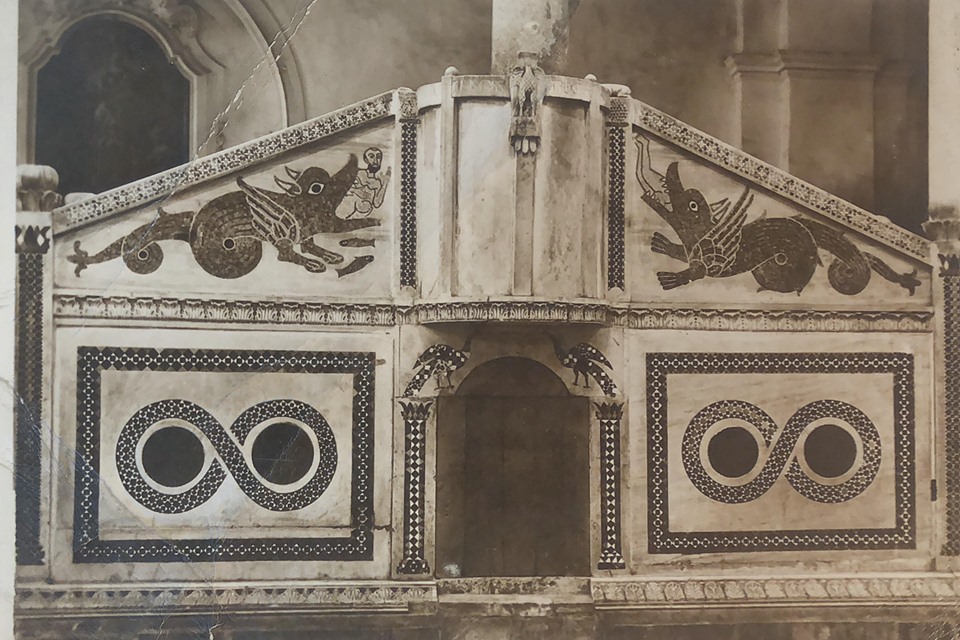

The steps of the Cathedral which the procession carrying statue had to stagger down on St Andrew’s Day
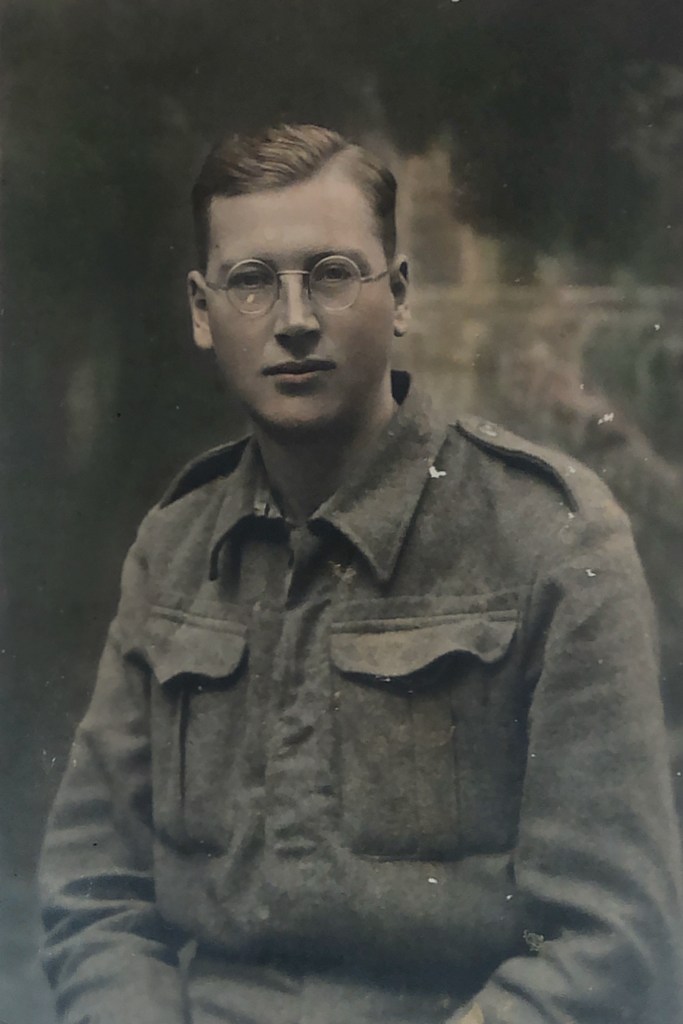
On the last day here we collected our photographs, and were pleased with the results. Then about 10am we boarded the truck and sadly turned our faces back to the front.
Immediately we got back to the Regiment we were put on guard and soon returned to the old routine. On the 8th of December we had a panic move, got up before it was light, but because of the heavy rain and thick mud, could not get the vehicle up the gradient of the orchard and out on to the road. So we had to get some heavy lorries to tow us out, which caused considerable delay. We eventually got to a place just under Mt Cammino, then got orders to return to our original position. It was not until the 18th of December that we moved forward and camped in a grand level site, under the shelter of huge Chestnut trees, near a place called Nochellino. We could see way down the valley and looking upwards could see the tops of the high range of mountains, as dawn breaks they look superb in the early morning light.
” As dawn breaks, the mountains look superb in the early morning light “
There was a lot of Artillery fire, some heavy stuff amongst it. The noise is terrific as the shells hurtle over the valley, and the noise reverberates from the opposing hills, and sounds just like an express train tearing along. Some of the shells don’t clear the crest of the mountain in front of us, and explode spectacularly, especially at night. The week before Christmas it rained incessantly and we were absolutely bogged down, our only shelter, apart from the Bivvies, is a small single storey Church, which is now our Cookhouse. It is a bare stone building, with small lancet windows. There is a raised floor at one end which was the alter, also at this end is a very big dingy oil painting of Daniel in the Lion’s Den. Previous to our occupation this church had been used by the Germans and there is a painting on the south wall of a German girl, with a background of grape laden vines, and some words in a rather artistic Gothic style, expressing the yearning to be back in the Homeland, saying how beautiful it was. The mud is so bad that all the rations and water had to be manhandled a considerable distance from the nearest road.
I was helping in the Cookhouse one morning, just before Christmas, when to our amazement an Italian funeral party arrived carrying a coffin. It seemed natural to give them a hand to dig the grave, after some discussion as to the precise location, we dug it in rather stony ground near to the Church door.
” The noise is terrific as the shells hurtle over the valley “
On Christmas Eve 1943 we had a celebration in the shelter of the Cookhouse and broached three bottles of ‘Ravello Gran Caruso’ wine, which we had brought back from Ravello on our last visit. The last thing I remembered was falling over a ‘bivvie’ on my way back to bed in the snow. Awakened on Christmas morning by Lofty Hammond with a cup of tea, in traditional style. After breakfast the sun came out, and in spite of the snow was tempted to have a bath. The Christmas dinner was an excellent spread, a menu of tinned turkey, roast spuds, stuffing and beans. Then pudding sauce and beer. The Old Church made a very appropriate place to have this Christmas celebration, after dinner and the beer everyone was in a soporific mood, and we listened to the radio, and he aired the Archbishop of Canterbury, Roosevelt and the King’s speeches, sprawled out on the alter. Half-way through the afternoon I had to go to 242 Battery and learnt that I should have to stay there for the night. On the way to the Battery I called in to see the rest of the Survey Party, who are still at the old camp at Rocamanfino, and was invited to sample their punch. I arrived at the Battery after dark and was welcomed with tea and mincepies.
For the next week I stayed at the L.A.D., somewhere near Grazzenise and amongst other repairs had a new clutch fitted. I got back to the Survey Party on the 9th of January 1944 and we did a couple of days Surveying, then moved on to Francolese and leaguered for the night.
The following day we went to Sessa, and found a good billet, everybody under a roof for once. Our Survey trucks were garaged in a yard at the back of the house, which was approached through a narrow archway, the 15 cwt trucks only had a couple of inches to spare and it became a matter of ‘honour’ to drive in and through at about 30mph., and not hit the sides, which we usually managed.
By the 17th of January the roads became choked with traffic, particularly Artillery, and the rumour was that a push was going in along this coastal section. Here at Sessa we expected to have a splendid view of the battle, as from here the whole area right across the coastal plain can be seen. True to the rumour, on the evening of the 17th, just as dusk was falling the barrage started and as it got darker there was a colossal firework display of tracers from Bofors and machine guns. Our guns kept firing salvo after salvo. At midnight the Survey Party were called out to help carry ammunition, which we had been doing all day, and unload another batch of shells. After this flurry of activity things quietened down, all this was concerned with the Anzio landings, further up the coast, in an attempt to force through Cassino.
On the 19th Harry and I went to Amalfi to the rest camp for four days. Did the usual things: ate, and drank a considerable quantity of wine, this time we hired a rowing boat and made a trip into the Blue Grotto, a large cave in the cliffs big enough to row round, in the pervading strange blue light. When we got back from this leave, also as usual, there was survey work to be done. Unexpectedly a Battery of 2nd Medium Regiment arrived to relieve one of ours.
Soon after this we moved to Fasani, a noisy place, between two Batteries of 4.5s, so it was fortunate that the next day we moved off again, this time further towards the coast though not such a healthy spot as we were in sight of the German O/P’s. Good views of the shelling from here and can see Minturno and Castleforte – still in enemy hands – and the bursts of our own shells. Though we were all undercover here, we shared an odorous barn with a few sheep and a donkey, also one night a couple of Iti’s turned up, ostensibly looking for some lost horses, who sheltered for the night in the straw. To our alarm they started smoking, with straw all around them, we had to tell them to stop this. From here we moved on to St Marie la Fossa and the next day to Alife, where Harry and I adapted a straw thatched hut for our quarters. It was proof against the rain and frost, and after we had built in some beds, was very cosy and comfortable.
” We shared an odorous barn with a few sheep and a donkey “
The weather at the end of February became bitterly cold and it rained every day, a miserable period. On the 13th it was still raining and had to go up to front on a recce.
The next day we had a football match, Survey vs. Signals. I think we won but it was extremely heavy going as the pitch was badly cut up by deep Tank tracks.
The event today, 15th of February was a visit to a Bath Unit which had been set up in the middle of a ploughed field, so that by the time we got back to the road we required another bath. During the evening we went to an E.N.S.A. show, which included June Clyde, a first class effort. We met a lot of the American Infantrymen here, all youngsters from the 36th Division, most of them really shattered by their experiences in the Cassino attacks. On the 19th of February 1944 I took the truck into Naples where I stayed for the night in the Transit Camp and saw a picture show called ‘Sahara’, which was a documentary film of pre-Allemein desert campaign. The next day picked up some stores at the Docks and then picked some Gunners at Villa Littoria, reinforcements and chaps returning from leave, bringing them back to R.H.Q. More trouble with the truck – petrol pump – and returned to the L.A.D. to get it fixed. No sooner had I got back than we moved on to Cervaro to within sight of Cassino.
Felt very uneasy on recce, as we were certain that we were being watched from the Monastery, towering above us and which dominates the whole area. The next day I took the rations and wireless batteries up to T.A.C., which is just through the gap where Route 6 squeezes past the end of Mt Trocchio, and then continues straight as a die over the flat valley bottom, homing on the town of Cassino, with the massive Mt Cairo and Monastery Hill as a menacing background. Whilst I was up at T.A.C. there was an air-raid on Monastery Hill. The bombers came in formation, a squadron at a time and extremely high, just flashes of silver against the clear blue sky. Plumes of smoke went up from the hillside and a few seconds later explosions of the bombs were heard, and then another Squadron flew in to repeat the treatment.
R.H.Q. were a few miles back St Pietrovarano and we were there on St David’s Day and celebrated by getting in a large quantity of local wine from a shop in the village which seemed to have an inexhaustible supply of really rough red vino, we used to take our spare petrol cans round to be filled, a drop of petrol didn’t make any difference to the taste. Some of the lads became addicted to the stuff and before long you could tell who they were by the colour of their teeth.
” The bombers came in formation, just flashes of silver against the clear blue sky “
The weather was improving day by day, this enabled us, in our leisure time to explore the countryside on foot, climbing the nearby hills and rocky outcrops. Willy and I used to get away on these excursions whenever we could. On the 8th of March I was detailed to take Lt Dashwood to Amalfi, so had another four days at the Rest Camp, the difference being that I had to do the driving. For the next four days I followed the old routine, cracking a few bottles of Vermouth and a trip to the Blue Grotto. Back at R.H.Q. by the 12th of March, where I was presented with a brand new 15 cwt Ford, Square Cab, angled windscreen. SUR 1. a bit roomier than the old Chev. Harry and I fixed our beds in it. Then on the very next day, wonders of wonders, I was sent down to Amalfi again, for another four days, this time Harry came along.
Did the usual things, but also Bed and Breakfast and Evening meal in an Italian House. The Landlady cooked us a super meal and we slept in luxurious beds, breakfasted on Omelettes, coffee, toast and marmalade. We also sent some lemons home. Returning on the 20th of March we saw Vesuvius in eruption. A huge plume of grey brown smoke and dust, with great spurts of rock and lava issuing from the crater. The slopes were smouldering and smoking as the lava flowed down burning up the vegetation, whilst for miles around the ground was covered in a thick ash, like a fall of grey snow.
” Returning, we saw Vesuvius in eruption “
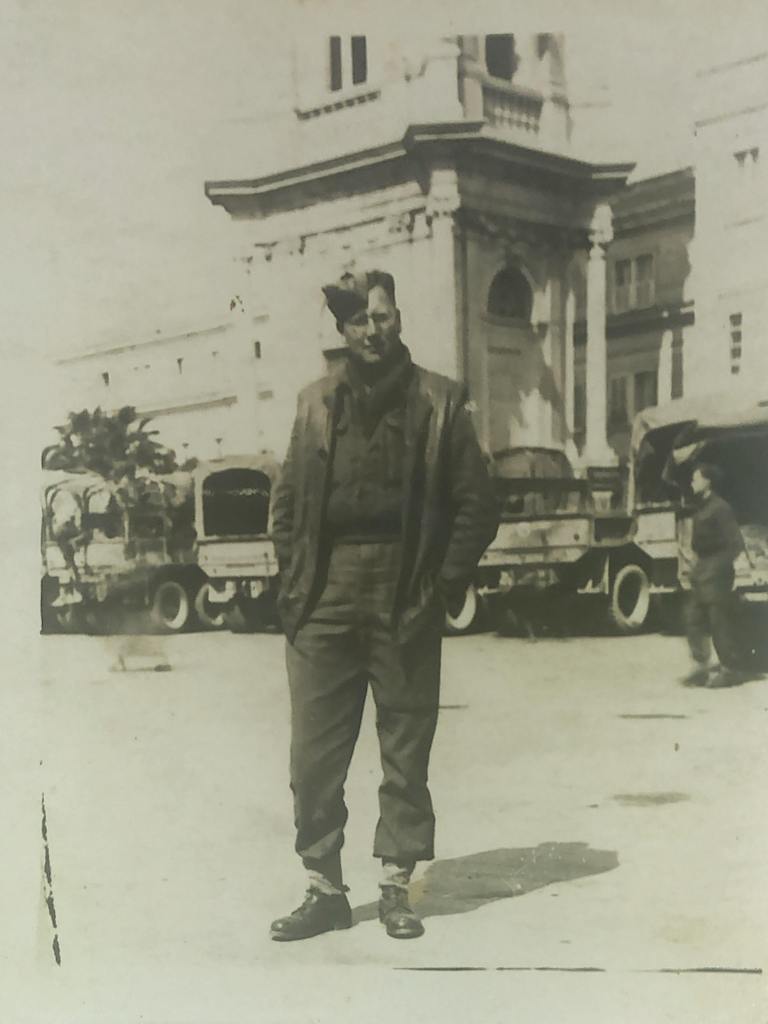
March 1944
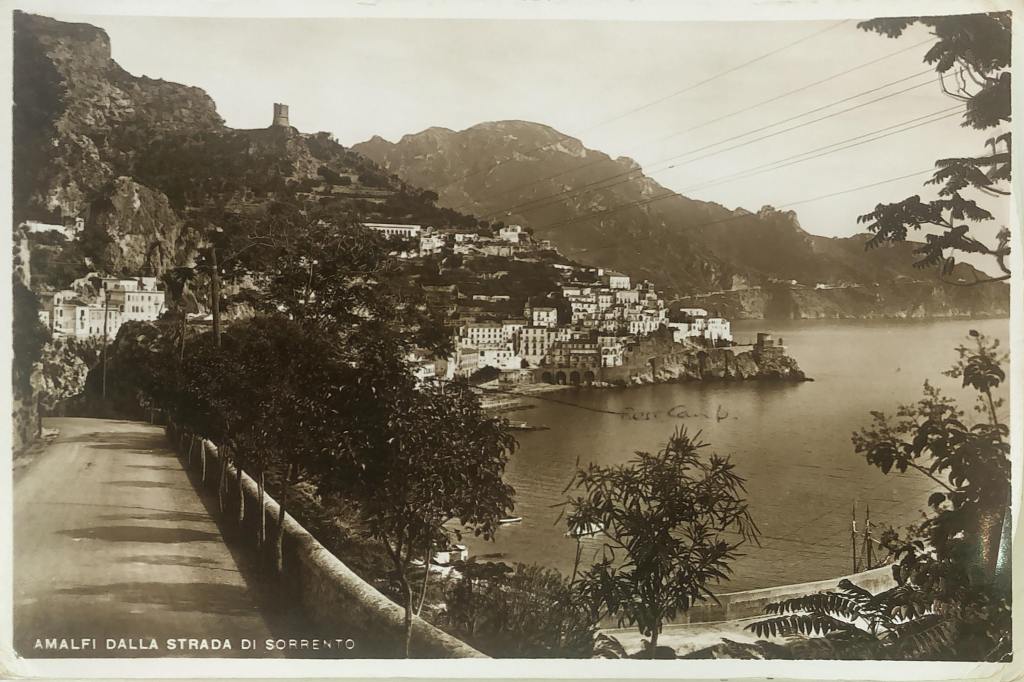
Amalfi Dalla Strada di Sorrento
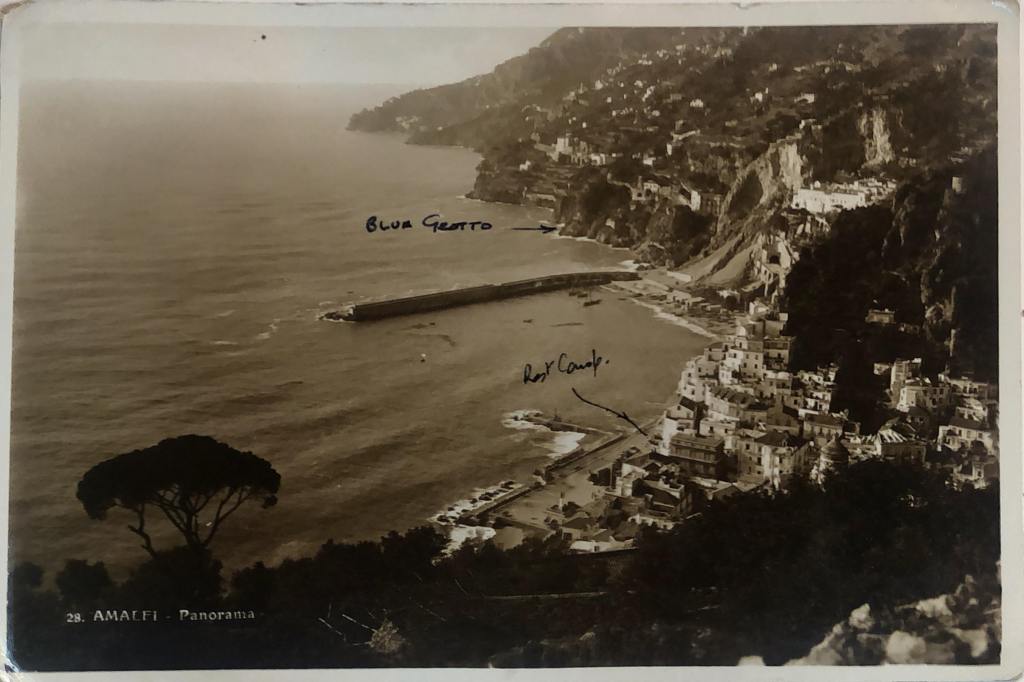
Annotations show locations of blue Grotto, and Rest Camp
On the 5th of April we left this sector and took the road to Compobasso where we halted for the night, on the next day we snaked our way through steep sided valleys and over rounded green hills. On the higher sections there were still the remains of snow drifts.
On the night of the 7th of April (Good Friday) we leagured within sight of the Adriatic. After crossing the river Sangro, we eventually pulled into an orchard site near Lanciano, an old hill town dominated by the Church. We could see the Church Tower from the Camp site, up across the other side of the valley, through a haze of apple blossom and greenery. It was Easter time and we thought of Easters past. There was a stream running along the bottom of the camp and beyond there were vineyards which were still being worked. The owners were busy pruning and tying them. Most of the work was done by women and girls, you could hear them laughing and talking among themselves all day, sometimes someone would break into song, at these times everything seemed at peace and idyllic. The contrast was the times shells came over, this happened regularly on most days.
” At these times everything seemed at peace and idyllic, the contrast was the times shells came over “
One day we lost two trucks in an air-raid on Lanciano, fortunately no one from the Regiment was hurt. By strange coincidence, I learnt after the war whilst talking to one of our staff at the L.R. (Lemarchand) that his father had been killed in this same raid. At the end of April the rain set in again and we were bogged down in the mud. This, with having no surveying to do and that we were subjected to a few salvo’s of Artillery fire from Jerry, nightly, and frequent noise of Spandau fire in the near distance, indicating night raids, was getting us down a bit and everyone’s spirits were low and much bad language.
However, at the beginning of May things improved, the weather got better and, to our delight and wonderment, nightingales started to sing in the orchard; their rolling liquid music competing with the gunfire. With the improvement of the weather we changed to K.D. and to pass the time we marked out a Deck-Tennis Court and played for hours on end. On the 29th of May the Regiment which was to relieve us arrived – Canadians. The next day we handed over all our equipment and had a grand party to celebrate.
” To our delight and wonderment, nightingales started to sing in the orchard; their rolling liquid music competing with the gunfire “
We left the area on the 2nd of June and boarded a train at San Vito, with no idea where we were bound, there were 25 of us to a cattle truck and we spent a very cramped night. The train followed the coast. We stopped at a station near Bari for breakfast.
Finally, we got to Taranto and here we marched to the Transit Camp on the outskirts of the town. The journey was quite an experience travelling about 30 miles at a leisurely speed with frequent halts. On one of these occasions we came alongside a stationary train which was going in the opposite direction. Our van stopped a Goods van which on investigation was piled up with cases of oranges. It didn’t take long before several cases were transferred, I’ve never tasted such delicious fruit. Though there were no Station Buffets on the line, we managed to get tea made at most of the stops by rushing along to the engine and asking the Driver to blow some steam into our tea cans from the steam release valve. A dangerous but effective method of tea-making.
Taranto seemed to be far from the war and we spent the time swimming, playing billiards, picture shows and sightseeing in Town. The Docks were well worth visiting: a few warships about, one a scuttled Italian Cruiser, also a lovely three masted Schooner, the Christopher Columbus, a naval training ship.
We found that it paid to say you were a Communist here, then you were immediately hauled into the local well stocked Headquarters and entertained with food and drink. George Nock, I think persuaded them that he was the Chief Commisar for London, and was a nightly visitor for the whole of our stay.
Our situation seemed ironic when we heard the news of the June 1944 Normandy landings and the death and destruction that it entailed. On the 11th of June 1944 we marched from the Transit Camp to Taranto Docks (three miles), with full kit and rifle, and boarded the S.S. Batory, a Polish registered Troopship. We were at sea for five days and landed at Port Said. It was an uneventful cruise. Also on board were 250 W.A.C.S. and though we were strictly segregated, each night they used to congregate on the Promenade Deck, with all the lads in the Well Deck below. There was shouted banter and all combined in a sing-song. From Port Said we went by train up the Delta to Mena.
” We heard the news of the June 1944 Normandy landings and the death and destruction that it entailed “
Fascinating scenery of Date Palm fringed canals, camels and bullock drawn carts, primitive water wheels and intensely green cultivation. People everywhere some riding diminutive Donkeys, the riders with legs hanging loosely almost touching the ground. At Mena we were back in the same Camp as we started in 1942 – Mersa.
On the 18th of June we began a week’s leave in Cairo. What a city! Teeming with people, the smart and the ragged and unbelievably noisy. Motor horns, trams, horse-drawn carts, donkeys, camels, street vendors, and boot-blacks each jostling with everybody else, all in brilliant sunshine. We stayed in a Hotel and every morning it seemed the whole of Cairo traversed through our bedroom. Paper sellers, vendors selling watches or underwear, the Hotel staff busily chasing them out of one door whilst another batch came in at the other, so it went on in a relaxed and good natured sort of way.
On the 25th we left Cario Main and travelled all night arriving by train to Rehovet near Tel-Aviv the next morning. It was a mile or so from the coast and was a stony desert place with a few stunted shrubs dotted here and there. We lived in tents but the Offices and Latrine blocks were wooden shacks, also dotted about. This was in great contrast to the dark green geometric patches of irrigated Orange Groves. A few Arabs used to wander across the area with their goats and camels, as they have no doubt done since biblical times. At night on guard and in the moonlight it was a strange eerie place, and in the early hours before dawn it was a struggle to keep your eyes open and to be on alert.
There was a lot of thieving going on from the tents, and though the guard was doubled and about 40 of us were on guard duty at night, stuff still disappeared.
On one night McKenzie’s kit was rifled and his valued Majong set was pinched, though he got little sympathy from the rest of the Survey Party. We even started playing cricket here, and went to the Pictures every night, the war was far away and almost forgotten.
Late in July, Willy and I were sent on a Survey Course to Almaza. Travelling there by train we were entertained by the usual pantomime at each station, where the platform was overrun by hawkers of everything under the sun, mainly food and drink. It was almost a ritual. The seller of wine would hand a bottle in through the window to a soldier who would take a swig and hand it on to someone else and so on until only the empty bottle was thrown back.
There was one dramatic incident at one of these stops when a Lemonade seller, carrying a huge carboy from which he poured the drink out into small glasses and offered these for sale. Just as the train was pulling out, someone on the train shattered this large glass container with a single shot from a revolver, and the poor shocked seller was drenched in lemonade. We breakfasted at Kantara and got our money changed into Piastres. The desert scene as dawn broke took me back to the times before Allemein when I first came out here.
We worked pretty hard on the course, classes started at 7-45 till 12-00, and then from 5-00 until 7-00. These hours were of course to avoid the terrific heat of the afternoon. The mornings were the most memorable, Reveille about 6-00 when someone would bring round tea. We were in tents with no sides, just a roof over the dug-out, and this was the only cool time of the day. The course lasted for a month, at the end of which time we took our second class Trade Test. We were back at Rehovet by the 10th of August. Nothing had changed.
” We were in tents with no sides, just a roof over the dug-out “
There had been a rumour that the Survey Party was overstrength, and someone would have to go. I expected it to be me, however there was some plot in the Office to get rid of Cyrill, and on the 12th the blow fell, he was accused of being inefficient and had a Trade Test sprung on him the following day. It seemed that we were on guard duty most of the nights and comtemplated the evening sky, the night sky, and the dawn on many occasions. On our time off we went into Rehovet for a meal and drinks and used to come back by the local bus, usually full of civilians, Syrians, Palestinians, Arabs, an amazing mixture. Had one trip into Tel-Aviv with its crowded beaches, and modern blocks of flats just like Southend and very expensive. Hugh James said he had to see relations in Jerusalem and arranged to go there on leave.
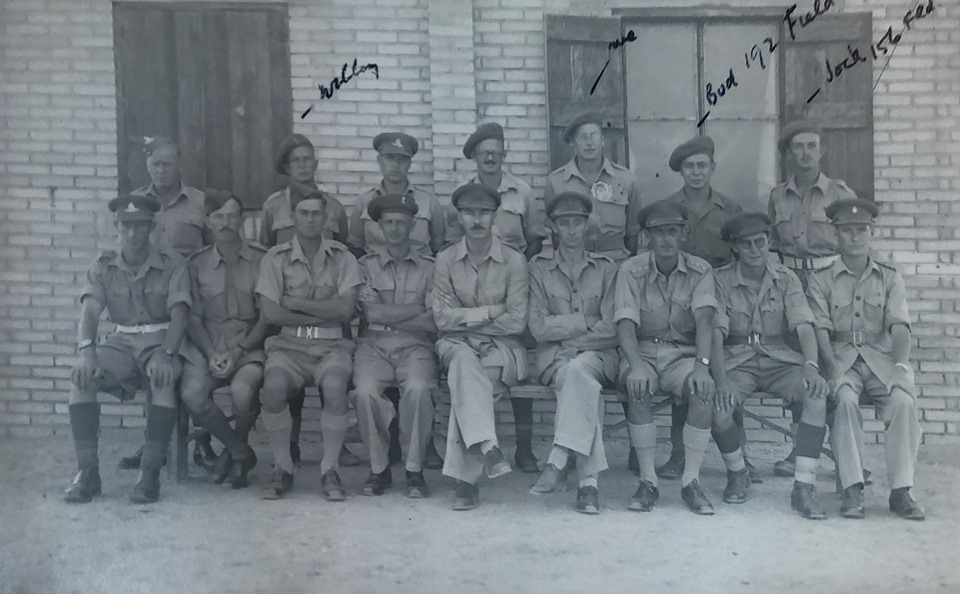
Left – right: Willy, Me, Bud 1942 Field Regt, Jack 156 FRd
On the 17th of August we packed up and took the desert road South, through Beersheba and crossed the Sinaii. Had to travel early to avoid the heat which during the day became overpowering. The distance became a shimmering mirage and it was difficult after a few hours driving to stay awake and I succumbed several times, the vehicle veered off the road and momentarily swung on to the desert. The only features on this dazzling yellow landscape were the black ribbon of the tarmac road and the occasional 40 gallon tar barrels left on the road side, and everything further ahead disappeared into the heat haze.
Arriving in Egypt we camped at Quassasin, a real sweltering hell hole of a camp near Ismaliya. We stayed here in this place of heat, dust and flies for two days, our relaxations were visits to the Y.M.C.A. or the N.A.A.F.I. (The Blue Kettle), had a swim in the warm and incredibly salty waters of Lake Timsah.
” We camped at Quassasin, a real sweltering hell hole of a camp “
On the 1st of September we moved and crossed the Nile Barrage and then North along the familiar desert road passing Wadi Natrun, and camped at Amiriya for the night.
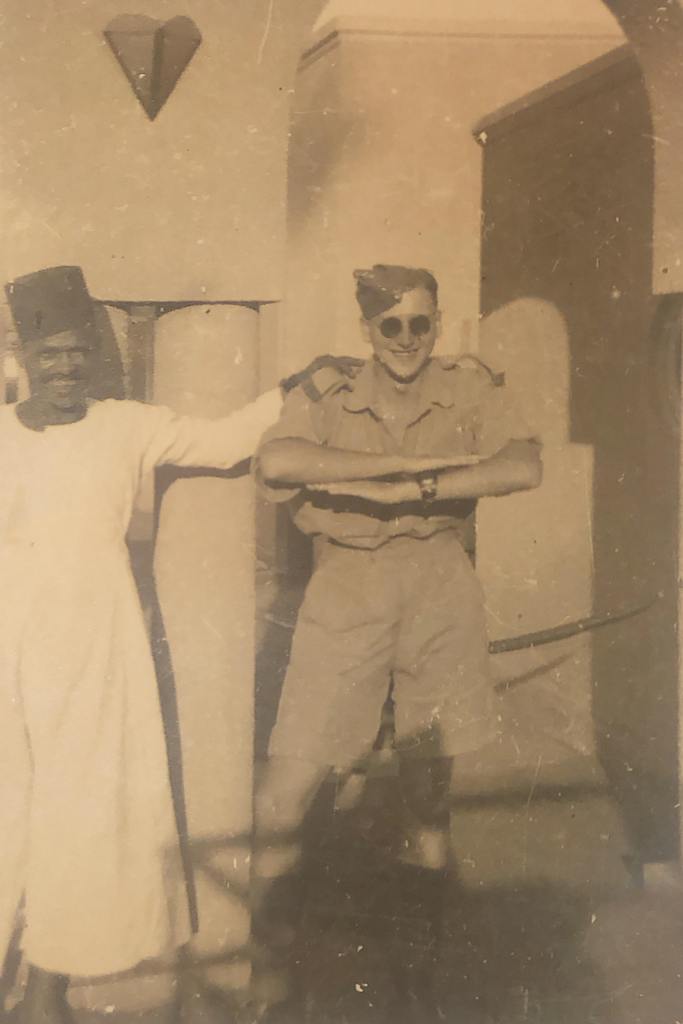
Which is me? I’m on the right with the dark glasses
The next day we continued into Alexandria, right to the dock-side and joined all the other vehicles and guns to wait loading onto a ship tied up on the opposite side of the quay, the Thistlemuir, which was a dirty grey merchantman. We had plenty of time to wait and were able to closely observe the animated bustling scene. Out in the harbour the tugs and lighters and even rowing boats were swarming round the transport ships. Further out there were Destroyers, Cruisers and an Air-Craft Carrier. The merchant ships being loaded and unloaded were flying several different flags. Whilst here on the quay there was a constant stream of Lorries, Horse-carts, Vans, Hand-carts, passing and bringing in sacks of sugar, flour and wheat which was built up into mountainous stacks on the quay and was being constantly craned up into the ships’ holds. Unfortunately, I was feeling bilious, either too much sun or something I’d eaten. I was glad of the opportunity to just lie there. The loading went on all night and at last at 1-30 in the morning of thee 5th of September my Jeep was lifted aboard. On board it was even more of a jumble than on the quay, we slept, ate and lived on deck amidst a confusion of rope, wire, chains and lorries.
That evening we sailed out into the Mediterranean, I was part of the crew of one of the Oerlikon Guns mounted on the sides of the boat, and watched from the Port aft turret the rest of the convoy disappear into the dusk as evening came on, only to reappear as ghost ships as the moon rose. For the next four days we sailed smoothly west on calm, blue, sunny waters. Leaning over the rail, chatting or just watching the water and at night contemplating the stars and the phosperescence, as the boats’ passage broke the waves.
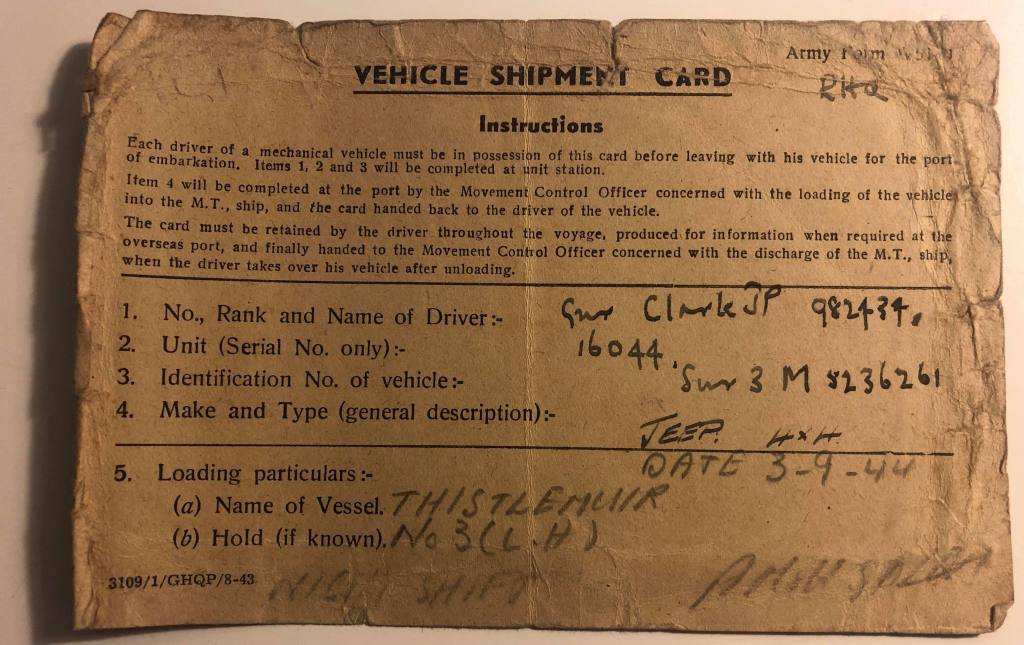
September 1944
On the 12th of September 1944 we sighted land, it turned out to be the Sicilian coast, and we anchored well out to sea off Port Augustus. This was rather puzzling as we wondered which side of Italy we were bound for? Or were we going somewhere else? Here riding at anchor we were allowed to swim, some of the experts diving from the deck, twenty or thirty feet below. I was less adventurous and went down by rope ladder.
” On the 12th of September 1944 we sighted land “
Harry and I decided to swim right round the ship’s hull. All was well along the sheltered side though it seemed a long way to the bows, not being a particularly strong swimmer. Going down the other side the water was a little rough and the wind was increasing. By this time however, I had reached the point of no return, even though I was decidedly tiring and a few mouthfuls of sea water didn’t help and to make things worse when I tried to hold on the side of the ship to have a breather, to find it absolutely smooth and finger holds made impossibly slippery with oil, which coated the entire water line, and once you got against the side the wind tended to keep you bumping against it, so before many minutes I was as coated with oil as the ship itself. I was thankful to turn the stern and in calmer water managed to reach the rope ladder and almost exhausted climbed up to the deck, where I had to have a bath in petrol to get rid of the sludge.
During the next night the wind increased considerably and the sea became rough enough for spray from the breaking waves to come right over the decks. This weather continued for the rest of the voyage and on the 14th of September we docked at Taranto, and occupied the same camp on the outskirts as we had left four months before.
As we had our vehicles with us now we didn’t have to march from the docks this time. Before the Jeep was slung out of the ship’s hold we prised some of the floor boards which were bedded on top of the cargo of sacks of sugar and hauled out a sack and put it in the back of the Jeep. This hundred weight of sugar augmented our rations for months to come. As we passed the Police at the Dock gates we felt like genuine smugglers.
” As we passed the Police at the Dock gates we felt like genuine smugglers “
It was not until the 24th the we moved on to Caserta, then followed Route 6 through Cassino to Valmontone. The route to Cassino was familiar. Cassino was an absolute ruin and though it was months since the battle had ended the only way through it was a narrow lane over the rubble.
It was from Valmontone that we first had a trip to Rome to see the sights. Saw the Coliseum, went to a Picture Gallery to see some XV and XVI century Old Masters, and to St Peters where we ascended to the roof, then up into the Dome and ever upwards into the Copper Ball, right on top with only the cross above us. It seemed a rather insecure position to be in, as the Ball did not appear to be very substantial and peering out of the small windows, though you had a splendid panoramic view of the whole city, looking down immediately below from this overhanging position was quite alarming.
One evening we went to a performance of the Barber of Seville in the Opera House. On the 8th of October, we moved to Cerignola which was nearer to Rome and here we were all undercover, even the vehicles. It was in an Exhibition Ground and the buildings were modern hanger like places. From here we had several trips to Rome, becoming familiar with the various restaurants which had been commandeered for the Troops. The meals were excellent. We also enjoyed seeing the sights, the Tiber, a really tawny brown flood, the Spanish Steps, the huge marble Vittoria Emanuel statue, and one night we went to the ballet, Coppelia. Also saw a soccer game Roma v R.E.s.
It was a shock to move on from here, but on the 29th we left and went up over the Appenines to Fignola and then on the next day to Figlini near Florence.
By the 1st of November 1944 we were just South of Borgo where we were fortunate enough to find ourselves a barn to sleep in, though one side was open to the winds, it was a welcome shelter as the rains had settled in. The valley we were in reminded me of Borrowdale, and at night all that could be heard was the swish of the rain and wind in the leaves of the trees and the watery sounds of the torrent cascading the hillside at the side of the barn. There was a Bailey Bridge across this stream just below us, and one day the R.E.s were busy shoring it up, as the recent rains were washing its foundations away. They had to stop the traffic whilst they worked to maintain it, just at that moment a Jeep came along with the General’s flag flying, it was Anthony Eden on a visit, he gave us a smile and a wave. When the Jeep stopped at the bridge he got out and looked over the parapet and smiled at the R.E.s below and said ‘Cheer up, it won’t last long now’ to which someone replied ‘What? The war or this fucking bridge?’
Some of the Survey Party stayed a few days at the Rest Camp at Fiesole in the Albergo Aurora, where there was a good Chef and plenty of Veamouth. Florence was nearby and here again we did the tourist round, the Vecchio Bridge, Uffizi and Pitti Palaces and the Duomo. We left here and by the 10th of November the Regiment were back in action, and it was here that we expected to spend the winter, as the Germans had established yet another fortified line ‘The Gothic’, and anyway a lot of the best troops had gone to help in Normandy, Italy from now on became of little public interest.
” It was like Russian Roulette, when you charged up one side and gambled that no one was doing likewise up the other “
It was a superb drive through mountain scenery, and to reach the Santerno Valley, we had to go over a high pass which was already covered in snow, going over the summit we saw a dramatic sunset. Where we entered the Santerno Valley it was at its narrowest, with wooded sides, no room at all to manoeuvre. The road too, is narrow and meandering, sometimes clinging high up the valley side and then plunging down to cross the river and continue its crazy course on the other side, over either a Bailey Bridge at river level or one high up on the old foundation of a former Viaduct, if the enemy demolition had not damaged the piers.
Out first billet was near the small town of Castel-del-Rio, where the only bridge through was a very high, but exceedingly narrow Medieval stone humped back Bridge, and was only passable to light traffic. It was so steep that until you reached the top of your orbit you were unable to see if anything was coming up the other side. It was like Russian Roulette, when you charged up one side and gambled that no one was doing likewise up the other. The building where we were billeted was a small two storey house perched high above the valley.
Harry and I used to sleep in a pig stye at the back, though to get in you had to get on hands and knees, it was dryer and warmer than a tent especially with winter coming on. It seemed that this was the winter line, so after the guns had been fixed, the Survey Party went back to more comfortable winter quarters. These were a huddle of small stone houses just off the road, a few miles back, with the River Santerno flowing in its rocky bed on the opposite side. The river was useful for washing down the Jeeps and there was a convenient place nearby where the vehicles could be driven into the water, and the fast flowing stream did the rest, and this was necessary as the Jeeps were absolutely plastered with mud after each trip out. The mud was so bad on some of the tracks that one day a Mule got stuck just in the drive to the billet, and had to be levered out with a plank under its belly.
” Harry and I used to sleep in a pig stye at the back “
One of the cottages was still occupied by the Italian tenants and though we Soldiers rather crowded them out, they certainly did not starve that winter. Us Surveyors had had an upstairs flat it was a bleak garret until Harry perfected a wood burning stove which warmed the place but tended to smoke us out, until after innumerable experiments the correct mix for making the clay to caulk the stove pipe. It was fortunate we had such a snug place to winter, as it turned out to be a severe one with gales, snow and ice.
As the winter progressed and because of the altitude and ‘hard’ conditions we were allowed an official Rum ration. When it was first issued it was almost a parade and we had to drink it there and then in the presence of an Officer, but as time went on we were just given the tot. So towards the middle of November we started to hoard it ready for Christmas and New Year celebrations. Also because of our isolation and high position, only a comparatively short walk took us to the ‘tops’. By walking up into the hills there were glorious views all around us, hills and mountains interlocking into the blue distance.
This was an area of steep meandering valleys running parallel to the North-East, and opening out into the Po Valley. The highest mountains were at our backs and were gradually getting lower as we went forward, but by some Geological freak, almost as the mountains levelled off into the plain there was a diagonal ridge of hills running across the general line of the valleys, and it was this barrier which enabled the Germans to hold the advance up. The other difficulty was that each of these parallel valleys were isolated from each other by a rib of mountains, about five miles wide, running between. So to get anything other than Mules or Jeeps from one valley to the other necessitated a journey of 70 miles, back up over the pass and then down the particular valley. Eventually a system of mile tracks over the mountains were adapted for communication, but even so were not east, and only possible when the ground was frozen, otherwise the wet moor and thick mud, bogged you down even in a Jeep.
The route we used to cross into the Senio Valley was called ‘Whip Track’. This lead from Fontalice and climbed up passing our O.P. in a ruined Farm; they never appreciated anyone using the track as any movement generally attracted a shelling from the German side. We had no surveying to do so spent the days, when the weather was not too bad exploring the area, having long walks up into the hills. The most conspicuous hill within reach was called ‘Point 1031’. At first, this took two and a quarter-hours to reach, but with practice over our eventual record was 1.5 hours in this in snow.
On the 20th of November 1944 Harry went into Hospital with ear trouble. He had been complaining about it for some time and at last the M.O. decided he needed treatment.
For most of November and December our main task roaming the hillsides on wooding expeditions and then chopping it up into suitable sizes to burn on Harry’s stove. I had the occasional trip to the Battery, and on one occasion had to act as a Guide to an Ammo Convoy into the next valley. Once we had to do a check survey, and there were always the vehicles to be maintained. The rest of the time, when the weather was bad we did a certain amount of reading and for a period Willy and I had a ‘puzzle craze’.
” We had an expedition into the woods for decoration materials “
We also had a lot of discussion about the recently announced Leave Scheme to England. Just before Christmas we had an expedition into the woods for decoration materials, holly, yew, hips, which we nailed around the room like a frieze.
On Christmas Eve, we painted the walls with seasonal designs, even the ceiling. Quite effective, I can see it still! Christmas was bright, snow all round so we decided to cross the river and stroll up into the hills, making our goal an isolated cottage which we had seen on a previous excursion. We were prepared with chocolate, soap, tobacco, and bully beef. As we approached, the door opened and a woman gave us a smiling greeting to our ‘Bueno Natale’. She invited us in to warm ourselves in front of a blazing twig fire. I had to stoop almost double to get through the door, and when inside had to stoop even lower as the rafters were hung with golden coloured Maize cobs, drying. Chairs were brought for us and roast chestnuts handed round. The husband was already ensconced in front of the fire. The family consisted of a daughter aged about 14, a son of about 10, and a little baby. It was certainly an education and quite humbling to see how some people live in such isolated places. We gave them the few things we had brought with us, and in return they gave us chestnuts and some garlic. Back to our Christmas dinner. A terrific meal, the table set with plates and glasses borrowed from the Italians in the cottage, quite a banquet.
” We had a hilarious party to celebrate the New Year “
On the 27th we were out on survey again in the snow, and it was at this time that we learned that two of the Survey Party will have to be posted. We don’t know who. I felt that I should be one of these, as I wasn’t in the original team. However, we had a hilarious party to celebrate the New Year. I was in charge of the bar and concocted a special brew for the mid-night toast. One bottle of Full Proof Rum, beer, cordial and wine, all boiled up to make a hot punch. It proved very potent, especially to Harry, who spent most of the night handing out of the window being sick on and off, at least he had to thank the high alcoholic content that he did not freeze and acted as anti-freeze, because it was a bitterly cold night. The weather was particularly severe around the beginning of January 1945 and even the plug points froze up on the Jeep, and had to be taken out each morning and heated up.
On January 4th, the expected blow fell on the Survey Party. Tich, Kaye and Tich Hyde were posted to 67th Field. But after two days they returned as the 67th were already over-strength.
It was also at this time that Harry was sent over to the Adriatic coast, on what we thought was a wild goose-chase to try and locate the Padre’s truck which had been stolen and was reported to have been found somewhere over this side of Italy.
In the middle of January there were one or two extra bright sunny days and then snow-covered slopes were most picturesque, and inspired us to try some winter sports. We made sledges and tried them out down the steep winding Bullock Track, above the Camp. The ultimate was reached when we built a huge Toboggan, to accommodate 10 riders. It proved to be not very speedy but once it had got momentum there was no stopping it, except for the stone wall at the corner of the track. The technique was to ride down the slope until you got near the bottom, then everyone had to abandon the sledge, by rolling off into the snow, before hitting the wall. On the 14th, Harry returned in triumph with the Padre’s truck.
At the start of February, the winter weather began to relent a little and gradually the snow began to melt and the brown hillside revealed looked radiant in the sunshine and giving off some hope of the spring to come.
” The snow began to melt and the brown hillside revealed looked radiant in the sunshine “
One day I went off on a lone ramble, climbing out and across the valley to where the hills formed a V in the skyline above here, and followed the as yet unexplored left form and started to climb out on to the tree covered skyline. Here I noticed a quick movement ahead. It was a weasel, its lithe brown and white body moving alertly through the low undergrowth. It disappeared into the bushes and amongst the snow which was lying patchily on the unexposed slope. Continuing up to the ridge revealed that the summit was about half a mile further up. This proved to be the summit of Mt Fabbro. Here, just as unexpectedly as I had seen the weasel, I met a Shepherd who pointed out the various landmarks and heights. He recounted how the Americans took the hill and indicated to me the actual spots where the dead lay. On the 5th of February we moved out, after three months in the one spot. It was a beastly day: rain, snow and cold. We retraced our steps along the road to the bottom of the pass and here pulled into the side of the road for the night. It was too cold to sleep, even though we were wearing heavy Motor-coats over our Overcoats. Chuck Swallow could not rest either, so we spent most of the night boiling water on a Primus stove for tea or Bovril.
The convoy moved off at 5am, and onto Forli, over a magnificent pass, which coiled its way first up and then down into the valley of the Po.
We took up our new position on Route 9, near Faenza. This was a different type of country altogether, though we could still see the mountains through which we had just come and spent the winter, also away to the North the ranges of the snow-covered Alps were clearly visible.
The surrounding countryside was flat and apparently barrier-less landscape. This turned out to be an illusion, as we soon found out the very next day, when we started survey. The barriers here consisted of canals and wide drainage ditches with huge earth banks, which had been used as defence lines and here the opposing forces had just been the width of a canal away from each other. The earth banks were dug into and tunnelled through until only a small observation hole was made through the face of the bank in order for the enemy movements to be seen. Mines were suspected here and we had to use a Mine Detector before we walked to some of the survey points. Sometimes I had to go to the Survey Report Centre which was in a nearby Church and one of the R.E.s who could play the Organ used to play as it was still undamaged. It was a strange and moving experience to listen to the strains of the organ being played within, the music varying from the martial to light sylvan notes and sometimes fading to a whisper then perhaps on to Tocata and fugue. The playing stops, and you find yourself hearing the discordant noises of Guinea Fowls from the farm opposite, punctuated by the distant gun fire from the front not far away.
At the end of February, the spring had really started, the trees and blossom were resplendent. The weather was ideal for being out on survey all day, and of course with the better weather military activity increased. In a way we welcomed this, after a winter of comparative inaction we were eager to get on with the job. Our guns were showing signs of wear and not shooting as they should, so it was decided to have a big calibration shoot. The fact that we were now out on the plain, with an open horizon made this an ideal opportunity. It was decided to start the shoot on the morning on the 28th of February, and previous to this the Survey Party had selected and fixed four forward stations. Harry and I had to set up out Director on the roof of a Farmhouse, with a signals truck below connected by radio to Fire Control to tell us when and what Battery were firing. The morning however proved to be too misty and even when the sun got up it did not disperse sufficiently for us to see more than 6000 yards, so the shoot was cancelled for the day. The next day there was no morning mist and the firing started in excellent visibility, a blue sunny sky with the sun behind us ideal for picking up the shell as it exploded with an expanding splash of dense black smoke in the windless blue sky. We made a total of 170 readings. Also saw several salvos from other Regiments and a dive bombing attack somewhere over to the North-West near Bologna. It took us about four days to work out the results of the calibration, eventually working out the muzzle velocity of all the 12 guns, quite an interesting exercise.
One night we all went into Ravenna to see a A.G.R.A. Pantomime Show which we thought very good and worth the trip.
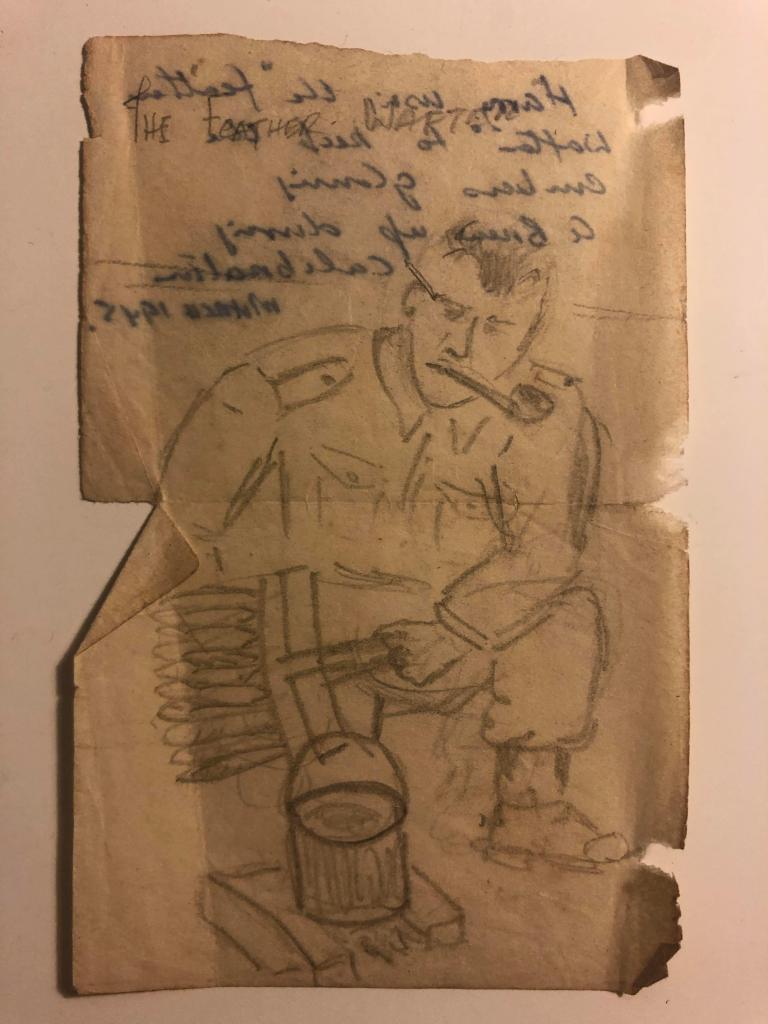
A brew up during Calibration’
March 1945

March 1945
On the 5th of March to another area, into another Farm. The Survey Party took a cottage nearby. We had more room here and set up a Deck Tennis Court in the orchard and used to play for hours at a stretch. We also got the idea of laying out a running track, so Willy and I measured out a 440-yard circuit in a paddock in front of the Farmhouse and used to time each other for a lap. Eventually almost everybody had a go and bets were taken. Another sporting event was a football match at the Faenza Stadium between our Regiment and 5th Medium. We all turned up in force and we were the winners, 2-0.
For the rest of March, we had little to do and spent most of the time playing Deck-quoits, and training on the Track. Individual times varied between 120 to 76 seconds for a lap. As an experiment we tried doing it in boots, I managed it in 86 seconds. On this site, as we were in an isolated building, we had to do our own guard at night, so we adopted a scheme for our own comfort, and the man on duty used to go up to an attic room on the roof, from where there was an all round view and here we kept watch. No alarms occurred and the night sounds of planes, guns, guinea fowl, cockerels, and the breeze in the trees was all that kept us awake. Our stay here ended on the last day of March, when we were ordered to move. The destination was a secret and all our Regimental signs were covered over.
When we had first come to the farm it was alive with Guinea Fowl, but though we had noticed the noise of these birds had decreased over our stay, no one could tell how these were disappearing and no evidence could be found to account for this. However, when we moved, I was helping the cooks to load the kitchen stuff, when we came to a pile of Ammo boxes which had been used to support the tables, and I was about to load these, when the Cook said ‘Leave those we shan’t want those’, and he opened one of these and showed me the contents: heaped there were unmistakably Guinea Fowl feathers.
On the first night of our move we leaguered at Ponteseive, just east of Florence, here Dashwood and Captain Taylor wanted to have a night out in Florence, so I took the Jeep and Tom also came along. After a trip to Fiesole we came back to Florence and coming back over the bridge, failed to stop at an Italian Check-point and had a shot fired over us, but by that time we were well clear and I kept my foot down and made a speedy return along the dark deserted roads. The next day we continued our journey and camped near Livorno, in a sandy Pine forest, with cones as big as your head. Here we settled down to wait: Operation Gold-flake. We had to wait for about a fortnight, which time we spent playing, Deck Quoits, Cricket, and had one or two visits to Pisa to see the sights. Very impressed by the leaning tower, and the various Churches, fine groups of buildings, and the decorative doors of the Cathedral, depicting all the animals and plants mentioned in the Bible, by Michelangelo.
It was on the 15th of April that we moved to Livorno Docks and boarded T.L.C. 394, and on the next day set sail on the calm Mediterranean. Sailing West, passing the island of Gorgona, which is a convict settlement. The sea and weather were so calm and still that every now and again we sailed through banks of think sea fog. These banks of fog could be seen from a distance and as we approached them they looked like a grey wall across the seas surface. Continuing Westward we skirted the Northern tip of Corsica and we could see the snow-covered Mt Cintro in the centre of the island.
” We met our first Russians here, we were not very impressed “
There was one frightening incident that occurred whilst we were passing through one of these fog banks, when we almost rammed another boat, which suddenly appeared out of the mist right across our bows, we held on grimly expecting a collision, but missed each other by the smallest of margins and the next minute both ships had disappeared into the fog. The next day we arrived at Marseilles, immediately disembarking. The waterfront was a bright, noisy place teeming with people and for me exuded the atmosphere of this Southern French port. Our convoy drove up the Main Street, competing with trams and civilian traffic, clear of the town and out to the North where there is a sandy bare scrub area on the outskirts of the town, here we staged for the night. We met our first Russians here, they had been prisoners and were on their way back to Russia. We were not very impressed.
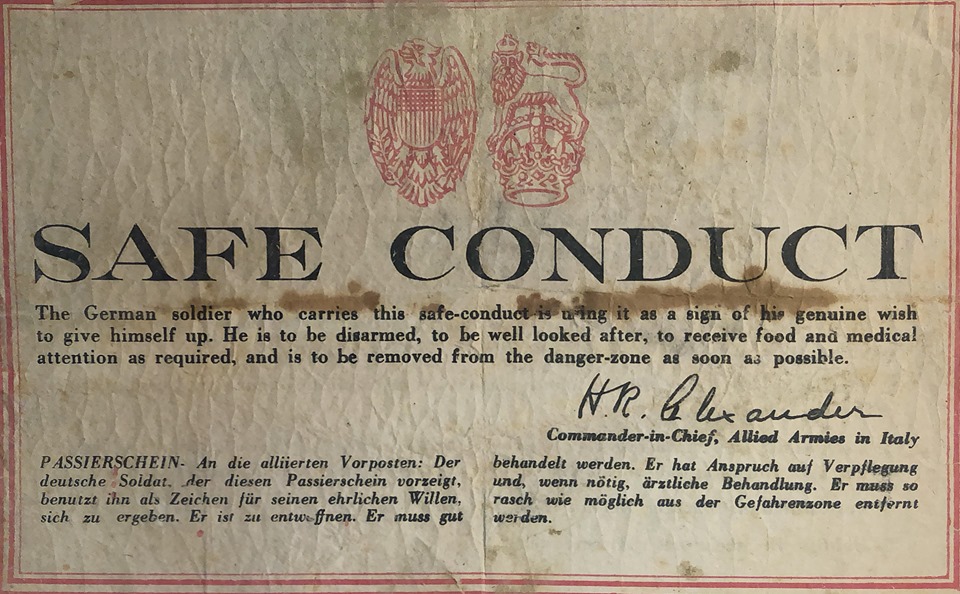
On the 19th of April 1945 we started the first of our day stages which were eventually to take us up the Belgian coast. We drive in convoy up the Rhone Valley, through delightful misty green scenery, as the sun rose each morning the colour of the Chestnut and Hawthorn blossom illuminated the landscape. The villages amazed us, in that all the houses were inhabited and had glass in all the windows, in great contrast to the village in Italy with which we had become so familiar. The only sign of war was the occasional burnt out hulk of German transport lying on the road’s edge.
From Marseilles, on the first night we staged at St Lambert, the following day we camped on the downs above Macon and strolled into the town in the evening and partook of the local wine. From here the Alps were plainly visible away to the East. The next day the Jeep broke down, one of the half-shafts went, and had to be winched onto one of the Three Tonners. However, Harry and I still travelled in the Jeep, viewing the rest of the journey from this exhalted position. Fontainbleu was the next night stop, camping in delightful parkland between avenues of Great Beechtrees.
The following day we went round the outskirts of Paris, and on to Turnout in Belgium just to the North-East of Antwerp. Here I had the amazing news that I was to be sent home on leave, and almost before I realised this, was given a pass and was on the train from Antwerp to Calais. Then on the boat and we crossed the olive green channel.
I stood at the rail watching for that smudge on the horizon which would indicate the white cliffs and the first glimpse of Blighty since we left the Clyde four years previously. From Dover to London where I phoned home to break the shock. Having some time to spare had a stroll up Victoria Street to Westminster though it was a blustery, showery day. Arriving at Norbury, I met Marjorie and Dad just outside the station, it was marvellous to see them again and it was all quite exciting. When we got to the house, Mum was busy with the meal. We embraced in the hall. It was a touching moment. It surprised me that everyone looked unchanged from what I remembered, and yet it seemed such an age I’d been away. My leave lasted from the the 27th of April to the 5th of May and seemed to go very quickly. One day I went over to Wimbledon to see Ernie’s people and visited the Locarno with Moira, Marjorie and Eric. Another day went up to the Land Registry and several of us went to a show and supper afterwards. Later saw a film, Henry V, and went to see Rita at Sutton. Also met Arnold who happened to be down in London. Above all enjoyed the home comforts and Mum’s cooking.
” Above all enjoyed the home comforts and Mum’s cooking “
I thought we had fired the last shots, but when I got back to the Regiment they were hammering away at the German Garrison still holding out in the isolated pocket at Dunkirk.
By the 7th of May, it was almost certain that the Germans would capitulate. At this time we were billeted in the village of Pitgam on the French-Belgium border. It was rather a drab village, and along its single Main Street, had several austere cafés, but had survived the tide of war pretty well. It was unique in that one of the local sports, though not all publicised, was cock fighting, and we went along one night to see one of these Mains. Didn’t enjoy it very much and thought it a very bloody business.
At last on the 8th of May the cease fire was ordered and immediately the flags came out and celebrations went with a swing lasting all night. The next day, the Mayor, a typical grey haired, old WW1 veteran organised an official ceremony around the flag draped War-Memorial. Where a scratch Brass Band played the Marseilleuse, a very emotional moment, and there were tears in the old boy’s eyes. It was a historic time.
On the 12th we left Pitgam and moved to St Omar, a larger though quieter and more subdued place, perhaps this was in reaction to the events of the last few days. Here we were stationed in some Old Brick built Barracks.
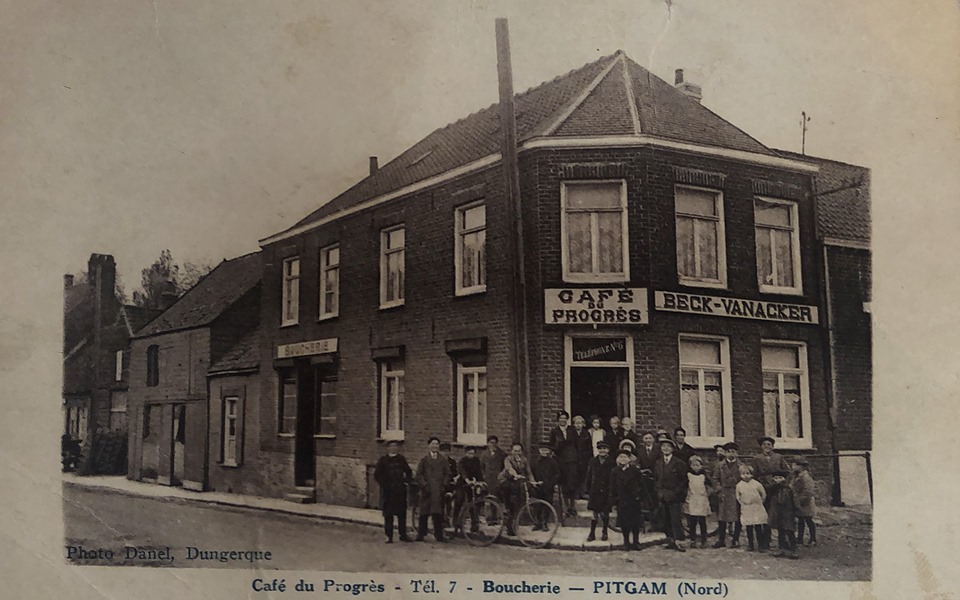
Cafe de Progres, Northern France
The next day I was given a 72 hour pass to Paris and stayed in the Ambassador’s Hotel, a five star hotel, even had uniformed Doormen, more used to serving Nazi Officers than us other ranks. It is situated in the Rue Haussman, and we were rather awed by its interior. We toured the sights, the Foiles Bergere and the Cassinao show, and enjoyed free Champagne. Stood at the Tomb of the Unknown Soldier, with the perpetual flame burning, and had a very interesting trip to Versailles.
” Stood at the Tomb of the Unknown Soldier, with the perpetual flame burning “
The 19th saw us back in St Omar, our job was now to collect German Transport out of the Dunkirk area. Dunkirk itself was a dead town, curtains flapping through the shattered glass windows. Street barracades made of piled up furniture, some of the drawers still containing their original contents, others half-open with clothing spilling from them. Everywhere was mined and German prisoners with horse transport were given the task of clearing them.
On the 21st had a day off and Willy and I went for a walk into the Forest of Clairmaris and ended up in the village of Arque, where we found a café and drank wine until late, luckily we got a lift back, as our sense of direction was a bit hazy by that time.
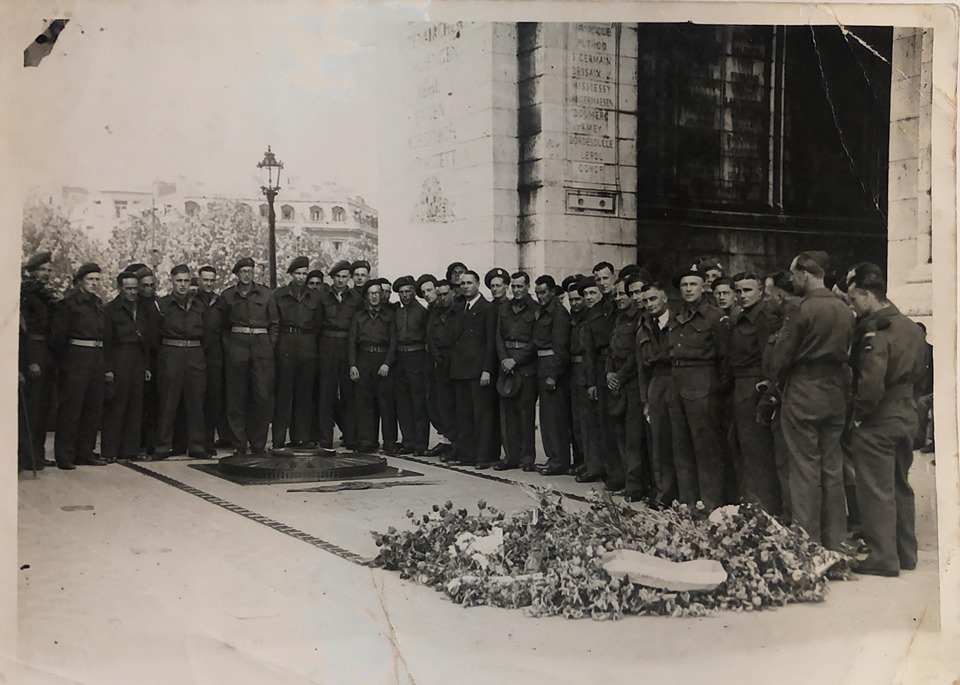
The Tomb of the Unknown Soldier
For the next fortnight we just hung around, a rather boring time. Though one day we saw a cycle race in the Cyclodrome, quite a festival occasion.
On the 5th of June we moved and stopped the night at Bourg-Leopold via Brussels and over the Maas at Venlo, continuing through Germany to Goch. Here we stayed in a bombed-out margarine factory which had been camouflaged as a church with a façade of wood and canvas, complete with a false spire. From here, our next stop was Rheydt, into a big school, one of the Strength Through Joy centres. This town was not so badly knocked about as Goch.
June the 10th saw a great upheaval in the Regiment. With reorganisation to a role as Occupying Troops. Harry and I became office boys.
On the 12th we crossed the Rhine at Weser and travelled on through Duisberg and Dusseldorf to Wickrath. The Rhur is at a complete standstill and not one of the myriad Factory chimneys show any smoke.
Here we took over a P.O.W. Camp from the Yanks, most of the Surveyors became members of the Motor Pool. We were billeted in a Stud Farm, with beds and electric light. The only clue to its former use was a life-size, lifelike model Horse, made of wood. The P.O.W. pens held up to 100,000 prisoners, a hell of a sight. Completely surrounded by high barbed wire fences with the usual Guard Towers. Inside the prisoners sat or stood like cattle, no shelter, except dug outs covered with blankets or sacking of every description. The numbers arriving very day completely overwhelmed our resources. The reason, we learned, was because they would rather surrender to us than risk being incarcerated by the Russians. They came shambling along the road to the camp in a disorganised mass. Eventually things improved. For one thing the Nazi S.S. were ferreted out and segregated, and the internal discipline was managed by the prisoners themselves. It was a common sight to see one poor bloke who had broken the rules having to wear a label round his neck with the word ‘Thief’ if he had been caught perhaps pinching someone else’s bread ration.
The weather throughout June was wet and thundery, with sudden darkening skies and tremendous rain, quite Wagnerian.
During July the weather improved, we patiently awaited news of some further leave concessions under the Python Scheme for 8th Army Troops. On the 30th of July I got news of my Python leave and all in my Group number gave a party to celebrate, in the Station Hotel in Wickrath: a noisy affair.
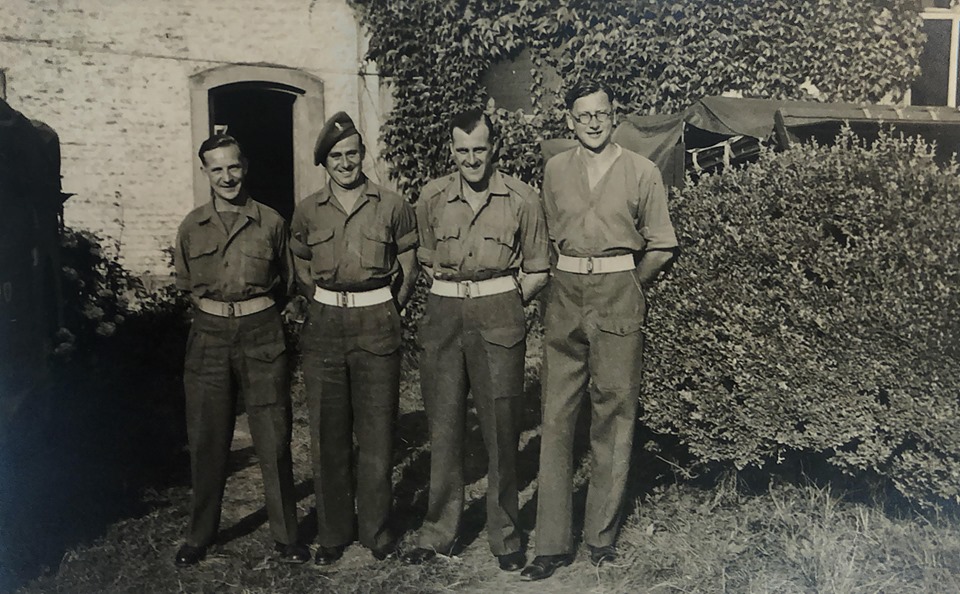
Wickrath
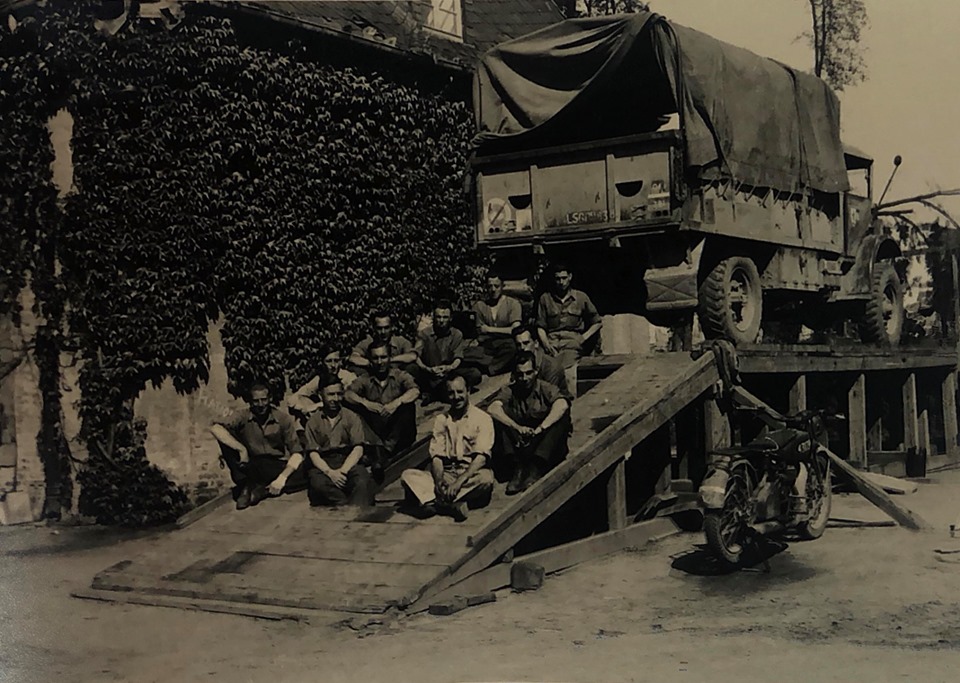
Wickrath, July 1945
On August the 1st 1945 we left the Regiment and went to Gennup, then on to Ostend, where we boarded the Invicta and crossed to Tilbury.
We finally landed up in Depot Battery at Woolwich, in Barrack rooms dating back to Victorian times. From here we were given 28 days leave, and at the end of this we had to report back to Woolwich. The duties here became so monotonous and boring, a strong reminder of my time in the Transit Camp in Tripoli, that I decided to enquire if I could get back to the 69th. After some delay I managed it and returned to Germany. By this time the Regiment were in some modern Barracks in Wuppertal, one of the numerous conurbations of towns making up the Rhur. The showpiece here was an unusual railway, which ran, suspended on a single overhead rail supported by a gantry straddling and following the course of the river Wuppoer. It was called a ‘Sweiberbahn’.
The war was over now and life was very different, we had very little to do except for a few Parades and Office duties. So had lots of leisure time, to involve ourselves in some mild black-marketing, this was done by contacting Works Managers, or Owners and arranging to get goods, perhaps tea sets of dinner services from some Pottery, or materials for dress lengths from Textile Factories. It was also possible to have jewellery made out of English silver coins, the signet rings were good. All this in exchange for cigarettes or food rations. Another Firm did a good line in leather luggage.


17 A.G.R.A. School
Wuppertal 1945
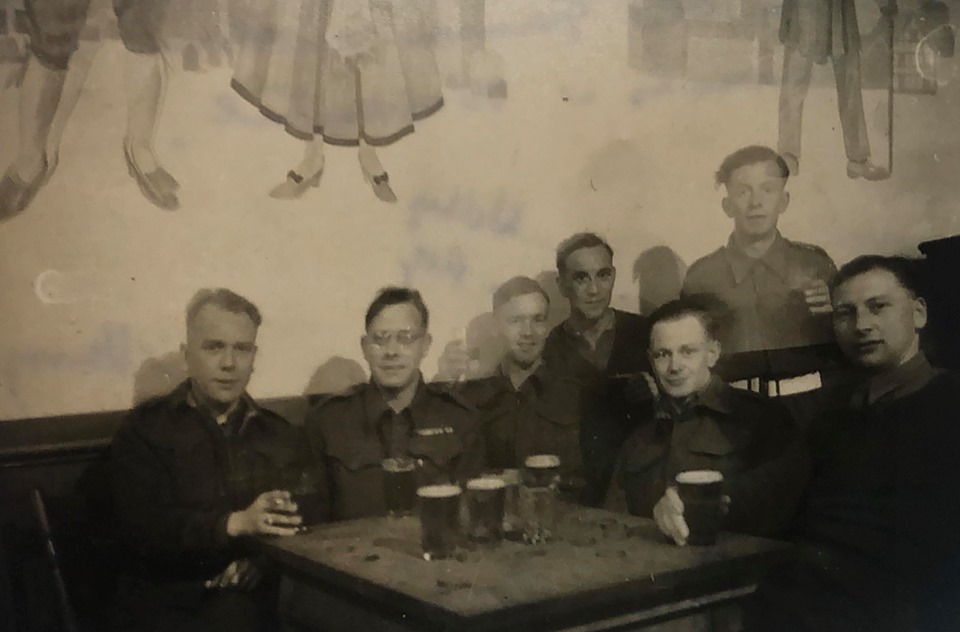
In German modern Barracks in Wuppertal
L – R: Harry, ?, Reg, Willy, Church, ?, Me
We also explored the District, walking the hills and woods above these Rhur towns and found that this industrial area was not a vast extent of large factories, but was made up of innumerable small, even one man workshops, and all this within walking distance of unspoiled hills and woods. This also accounting for the difficulty that the Air-force had had in affecting industrial production. There was a lot of talk and preparation for Demob. Willy and I were sent on a Residential College and studied Maths. We wrote essays on all sorts of subjects with the object of teaching the rest of the Regiment these subjects when we got back to the Unit.
At last on the 19th of March 1946 I finally left the Regiment and again crossed the Channel from Calais to Dover. Stayed for the night in Dover Barracks, then on to the Mid-Kent Railway to Reading, This took a long time, and it was not a corridor train so no facilities to relieve oneself. Before long some of the chaps became desperate, so equally desperate action had to be taken This meant that with a colleague holding his arms on either side and his bare bum through the window the desperate soldier relieved himself, whilst the rest of the carriage were doubled up with laughter. Especially if during the performance we flashed through a station or village.
” I finally left the Regiment and again crossed the Channel from Calais to Dover “
On the 22nd of March we travelled to London and to the Demob Centre at Olympia, where we selected our Demob Outfits. I chose a blue suit, Trilby hat, civvy shoes, shirt and tie. A Civilian once again. Mighty thankful that I had survived the ordeal which had gone on for almost the last six years.
” Mighty thankful that I had survived the ordeal which had gone on for almost the last six years “
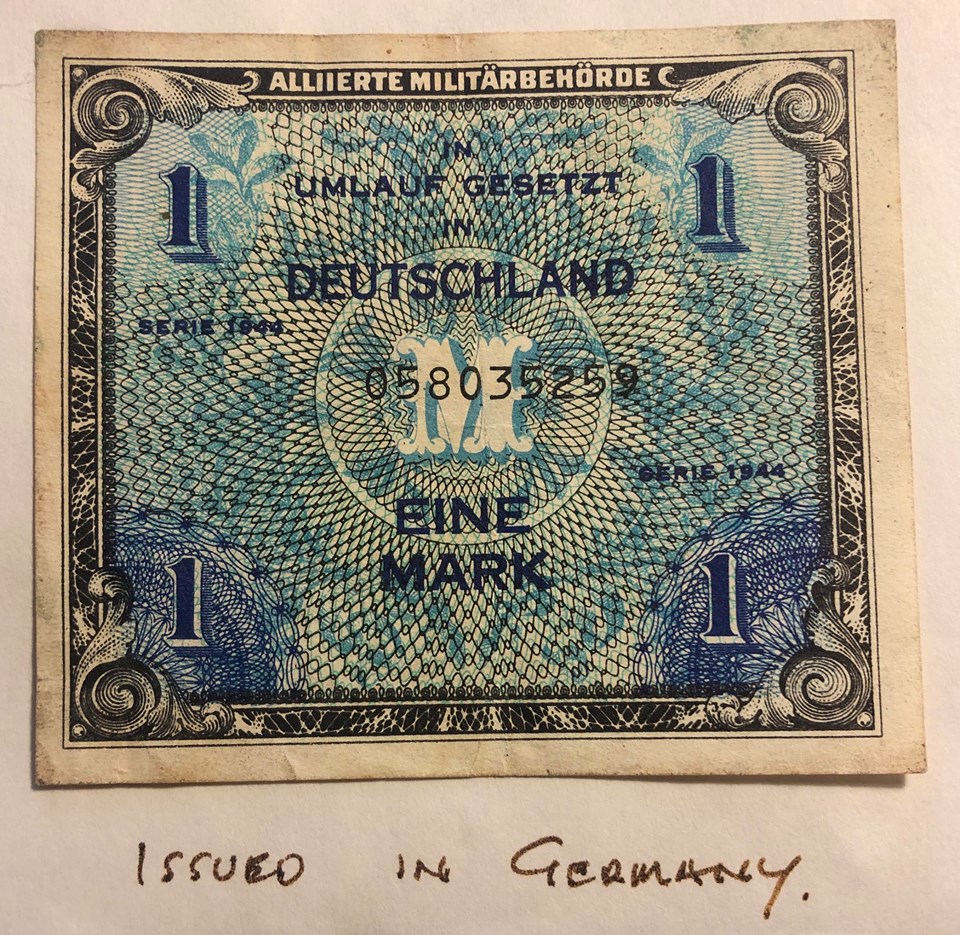
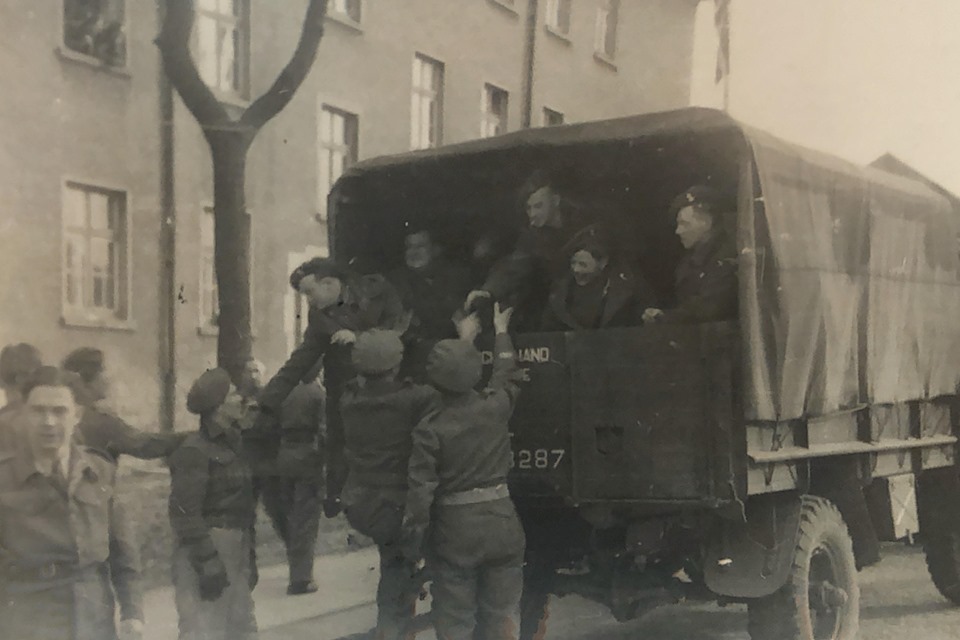
Demob, Group 27, Leave for England
1946
John returned to England and his career at The Land Registry; it’s here that Delys ‘saw his potential’. They married on 11th December 1948 and set up home shortly after, first in a caravan named ‘Cumbria’ (due to the post-war homes shortage) where Karen was born in May 1950, and then at 186 Limpsfield Road, Warlingham, where Paul came along in May 1952.
Throughout his life, John never lost his love for nature, entertaining, and sports; passions he went on to share with both his children and grandchildren (Bella, Amber, Kirsty, Natalie and Rebecca). These joint interests form the basis of many great memories for all of us, and we now have the pleasure of sharing these with the next generation (Leo, Josie and Charlie).
Having survived six challenging years in the Army, John enjoyed a further 63 happy ones and passed away in 2009 at the ripe old age of 92.
He was a kind-hearted man, a caring husband, a keen and interested father and a generous, gentle man. I know I speak on behalf of my entire family when I say I am honoured to have known and been influenced by him.
 Surveying the Front: The collected War Diaries of John Pexton Clark